Shrimp, Scuds and the Hidden Aquarium Ecosystem
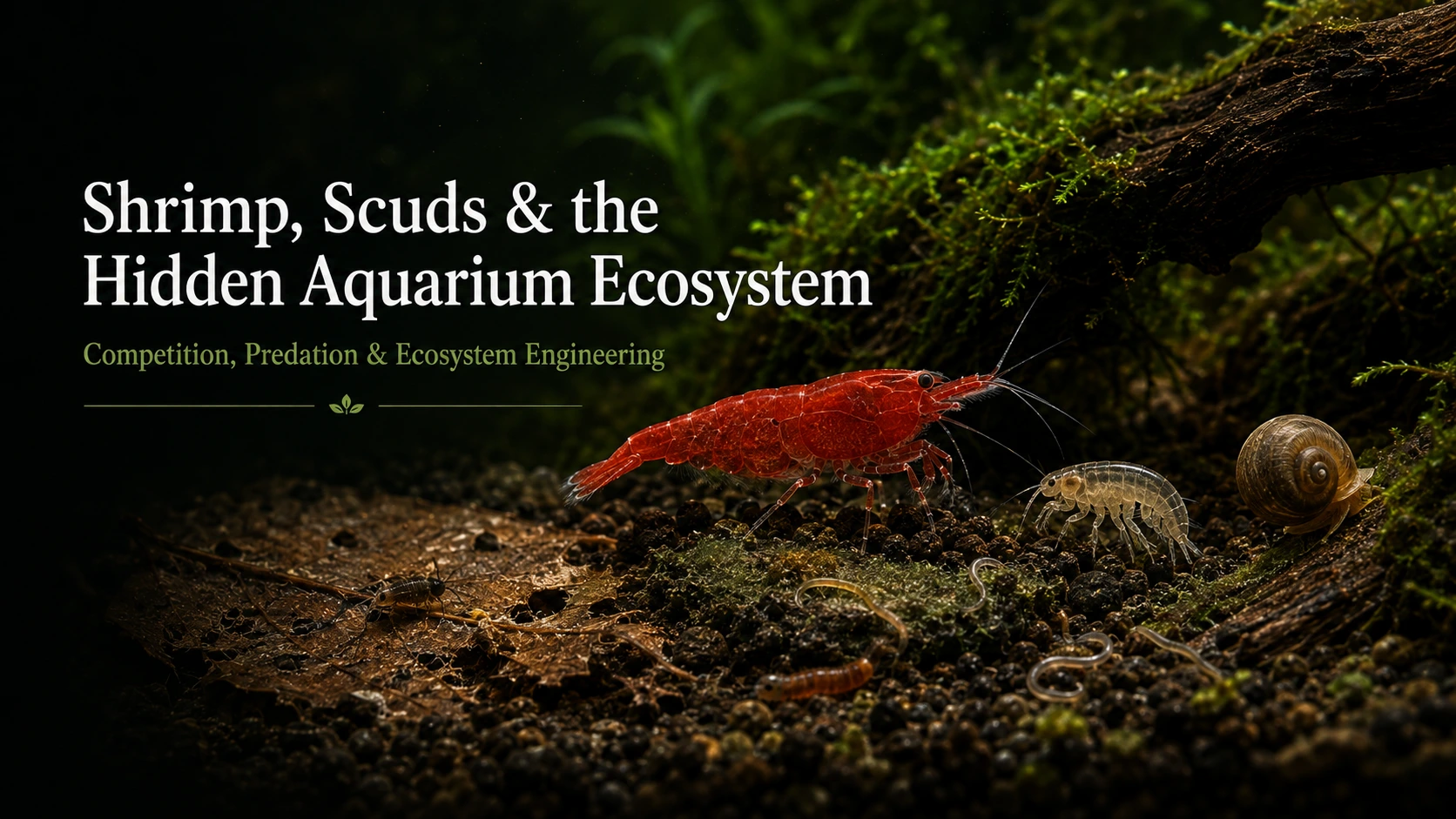
How competition, predation and ecosystem engineering shape the aquarium food web
A mature aquarium is not inhabited by shrimp alone. Beneath the plants, wood, stones and substrate lives a wider community of scuds, snails, worms, copepods, ostracods, flatworms and other small animals. Some are introduced deliberately, while others arrive unnoticed on plants, leaf litter, substrate or livestock.
Aquarists often ask whether each organism is beneficial or harmful. Biology is rarely that simple. The effect of an animal depends on what it eats, how quickly it reproduces, how abundant it becomes and whether its ecological role is compatible with the purpose of the aquarium.
A few scuds in a naturalistic fish tank may provide useful live prey. The same scuds in a selective shrimp-breeding tank may consume food intended for juveniles and make breeding results harder to interpret. Snails can process leftover food and disturb the substrate, but a population explosion may reveal that far more nutrition is entering the aquarium than the shrimp can use.
This article combines direct evidence from ornamental shrimp research with findings from freshwater ecology. Some aquarium-specific interactions—particularly scud predation on Neocaridina and long-term competition between ornamental shrimp species—have not been tested in controlled experiments. Where direct evidence is absent, the proposed mechanisms should be treated as biologically plausible explanations rather than proven outcomes.
The central idea is:
Aquarium microfauna are not automatically pests or cleanup crews. They are populations occupying different roles within a small, enclosed food web.
1.) The Microbial Foundation of the Food Web
The visible aquarium food web is built on an invisible microbial foundation.
Leaves, uneaten food, faeces and dead organisms are colonised by bacteria, fungi, algae and protozoa. These microorganisms chemically break down organic material, trap dissolved nutrients and create the biofilm that shrimp and many other aquarium animals graze.
A simplified pathway is:
Food, leaves and waste → microorganisms and biofilm → shrimp, scuds, snails and worms → fish and larger predators
The arrows do not show a single straight food chain. They represent a network. Shrimp may consume microorganisms directly, but they may also eat nematodes, oligochaetes and other tiny animals. A controlled microcosm study found that Neocaridina davidi frequently consumed freshwater meiofauna—small animals living among sediment and biofilm—and reduced the density and biomass of several groups. Cherry shrimp are therefore not merely passive algae eaters; they are flexible omnivores within the lower food web.
Biofilm can support much of the Neocaridina life cycle, particularly when juveniles have access to mature, grazeable surfaces. Experiments with biofilm-based culture systems have shown benefits for shrimp growth, survival and reproduction, although the nutritional value of biofilm varies with its microbial composition, age, light exposure and available organic matter.
This microbial foundation matters because feeding does not support only the animals we intend to feed. Powder, pellets and leaf litter also feed bacteria, fungi, protozoa, worms, scuds and snails. Every food input changes the possible size and structure of the wider aquarium community.
2.) Niches, Competition and Ecosystem Engineering
In ecology, a niche describes how an organism lives. It includes the resources it uses, the conditions it tolerates and the ways it interacts with other species.
Two organisms show niche overlap when they depend on many of the same resources. Cherry shrimp and scuds may both consume biofilm, softened leaves, powdered food, carrion and fine detritus. They do not need to attack each other to compete. When one population consumes a shared resource before the other can reach it, this is called exploitative competition.
Other interactions change the habitat itself. Scuds fragment leaves, snails graze and disturb sediment, and worms move organic particles through the substrate. Animals that physically or chemically modify the environment experienced by other organisms are called ecosystem engineers.
The keeper is the most influential ecosystem engineer in the aquarium. Feeding frequency, leaf-litter depth, filtration, substrate design and predator presence determine which organisms can establish and how large their populations can become.
3.) What Scuds Actually Are
“Scud” is an informal term for small freshwater crustaceans in the order Amphipoda. It does not identify one species, and different scuds may have very different diets and behaviours.
Aquarium scuds may belong to genera such as Gammarus, Hyalella, Crangonyx or Dikerogammarus. Underground and cave-associated amphipods such as Niphargus are less likely to occur in ordinary aquarium cultures. Some amphipods are primarily leaf shredders and scavengers, while others are more strongly omnivorous or predatory.
Even animals that appear almost identical may be genetically distinct. Hyalella azteca, for example, is now recognised as a complex containing numerous cryptic lineages. A cryptic species is a separate species that is difficult to distinguish from related species by appearance alone. These lineages can differ in ecology and sensitivity to environmental conditions, which makes broad statements about “all scuds” unreliable.
How scuds reproduce
Female amphipods carry eggs in a ventral brood chamber called a marsupium. This structure is formed by plates beneath the body and functions rather like an external pouch. The offspring are released as small juveniles rather than free-swimming larvae.
Reproductive rate varies substantially among species and with temperature, food and body size. Some Gammarus populations can produce several broods per female and support overlapping generations during favourable seasons. This relatively rapid generation turnover is one reason scud populations can increase quickly in warm, well-fed aquaria.
4.) Scuds and Shrimp: Different Evolutionary Strategies
Scuds and ornamental shrimp are both malacostracan crustaceans, but they belong to different evolutionary orders.
Scuds are amphipods. Their bodies are usually compressed from side to side, and they lack the large carapace covering the front of a shrimp’s body. Their limbs are adapted for crawling, gripping, swimming and handling coarse pieces of organic matter.
Neocaridina and Caridina are decapod crustaceans in the infraorder Caridea. They possess a carapace, stalked eyes and specialised feeding appendages. Atyid shrimp are particularly effective at brushing and collecting fine particles from biofilm and other surfaces.
These body plans represent different evolutionary solutions to life among plants, stones and decaying vegetation. Scuds often function as shredders, biting leaves into smaller pieces. Shrimp are generally better suited to grazing fine microbial films and collecting small particles.
Their roles nevertheless overlap. Both groups may consume dead animals, softened leaves, microorganisms and prepared foods. The question is not whether their diets overlap at all, but how much the overlap matters at their particular population densities.
5.) Where the Main Aquarium Shrimp Fit
Neocaridina davidi
The common cherry shrimp, Neocaridina davidi, is an adaptable omnivore, biofilm grazer and detritivore. A detritivore consumes decomposing organic material and the microorganisms growing on it.
Neocaridina has direct development. Its eggs hatch into miniature benthic shrimp rather than free-swimming larvae. The newborn juveniles therefore enter the bottom-dwelling food web immediately and depend on fine particles, biofilm and sheltered grazing surfaces.
Early juvenile stages differ in their response to food shortage, and extended deprivation can affect growth and survival. This makes access—not merely total food quantity—especially important. A pellet surrounded by adults may provide excellent nutrition while remaining effectively unavailable to a juvenile hidden in moss.
Bee-type Caridina
Bee shrimp, commonly associated with Caridina cantonensis, Caridina logemanni and closely related selected lines, occupy a broadly similar feeding niche. They also graze biofilm, decomposing material and prepared food.
Their physiological niche differs, however. Bee shrimp are normally maintained in softer water with low alkalinity and mildly acidic conditions. Two shrimp groups may therefore use similar food while showing different growth, moulting and reproductive performance under the same water chemistry.
Amano shrimp: Caridina multidentata
Amano shrimp occupy a distinct position in the food web. They are larger, highly mobile grazers and scavengers that can consume algae, biofilm, detritus and prepared food across a wide area.
Their reproduction differs sharply from that of Neocaridina. Adults live and reproduce in freshwater, but the numerous small larvae normally require saline conditions for successful development. This life history is called amphidromy: larvae move downstream to brackish or marine habitat, develop there, and juveniles later return to freshwater.
Amano shrimp therefore exert strong individual grazing pressure without normally creating a rapidly expanding freshwater population. At concentrated feeding sites they may outcompete smaller shrimp through body size and mobility, but this is competition for access rather than evidence of aggression.
Sulawesi Caridina
The ancient lakes of Sulawesi contain highly specialised Caridina lineages. Some occupy narrow rocky habitats, while Caridina spongicola forms a close association with a freshwater sponge in Lake Towuti. These shrimp demonstrate how specialised ecological niches can evolve even within one genus.
Sulawesi shrimp should not be treated as generic equivalents of bee shrimp or Neocaridina. Their evolution and husbandry deserve a dedicated article; here, their main importance is showing that the label Caridina does not describe one ecology or one set of requirements.
6.) Mixing Neocaridina and Bee Shrimp: Competition or Environmental Filtering?
Aquarists sometimes maintain Neocaridina and bee shrimp together in compromise water, often around pH 6.7–7.2. Both groups may remain alive, but pH alone does not describe the aquarium environment. General hardness, carbonate hardness, conductivity, temperature, substrate buffering and mineral balance may be equally important.
If one species gradually becomes dominant, two different processes may be responsible.
The first is competition. Both species use similar food and habitat, and one population removes enough of those resources to reduce the other’s reproduction.
The second is environmental filtering. This means that the physical or chemical environment favours one species before competition is even considered. The less-suitable species may reproduce poorly because of mineral balance, temperature or moulting conditions, even when food is abundant.
The two mechanisms can also interact. Water chemistry may reduce bee-shrimp juvenile survival, while Neocaridina simultaneously consumes a larger share of food. Observing that one population increases while the other declines does not, by itself, prove competitive exclusion. Ecological experiments show that environmental suitability and competition can produce similar population patterns and may change one another’s effects.
There appears to be little controlled research directly comparing long-term mixed populations of ornamental Neocaridina and bee shrimp. The safest conclusion is therefore:
Compromise water may allow both groups to survive without allowing both to reproduce equally well.
A mixed tank should be evaluated by counting juvenile recruitment from each group over several generations. Adult survival alone can conceal gradual demographic replacement.
7.) Scuds: Competition, Predation and Scavenging
In many shrimp tanks, competition is probably a more consistent scud effect than direct predation.
Scuds and shrimp may consume the same powdered foods, softened leaves, biofilm, dead animals and protein-rich fragments. Scuds are mobile and can enter narrow spaces, so a large population may consume food intended for newly hatched shrimp before the shrimp can use it.
Density is critical. Ten scuds in a mature tank may have little measurable effect. Thousands can represent a major share of the aquarium’s consumer biomass.
Direct predation is more complicated. Several situations must be separated:
1.) An amphipod attacks a healthy adult shrimp.
2.) It captures a very small juvenile.
3.) It feeds on a weak or freshly moulted shrimp.
4.) It scavenges an animal that was already dying or dead.
Some amphipods are capable predators. The invasive Dikerogammarus villosus, for example, can prey upon other freshwater invertebrates and alter the abundance or behaviour of competing detritivores. That does not mean that every small aquarium scud behaves like D. villosus.
Freshly moulted shrimp have soft exoskeletons and reduced physical protection, while tiny juveniles are easier to restrain than adults. These stages are biologically more plausible targets. Even so, scuds gathering on a carcass do not prove that they caused the death.
The animal seen consuming a body is not necessarily the animal that killed it.
The balanced conclusion is that scuds probably compete with healthy shrimp more commonly than they actively prey upon them, but risk rises with amphipod size, density and shrimp vulnerability.
8.) Can Scuds Be Selectively Bred for Colour?
Scuds can show natural differences in pigmentation. Individuals may appear brown, green, reddish, pale or nearly white. Pigmentation polymorphism—meaning the presence of several stable-looking colour forms within one population—has been documented in Dikerogammarus villosus.
Colour is not necessarily genetic. Diet, background, age, moult stage, parasites and health can all alter appearance. A brightly coloured parasite may even change the apparent colour of an amphipod host.
Published research documents natural pigmentation variation, but I found no well-documented ornamental scud strain stabilised through selective breeding to the level of Red Cherry or Blue Dream Neocaridina. This does not mean such selection is impossible; it means the inheritance has not been demonstrated clearly.
A breeding project would require:
1.) Identifying the amphipod species or lineage.
2.) Isolating unusually coloured individuals.
3.) Standardising food, lighting and background.
4.) Recording colour across several moults.
5.) Breeding selected animals separately.
6.) Tracking segregation of colour among their offspring.
7.) Repeating selection over several generations.
Because females brood juveniles directly and some species reproduce quickly, scuds could be suitable for a small selection experiment. The main difficulty would be separating heritable pigmentation from environmental colour change or infection.
9.) Scuds in Predatory Fish Aquariums
The same scud population that competes with shrimp can be extremely useful in a fish-centred ecosystem.
Scuds consume leaves, microorganisms, algae and prepared food, then convert these resources into mobile animal biomass that fish can capture. This creates a detrital energy pathway:
Leaves and microorganisms → scuds → fish
Predatory and insect-eating fish cannot obtain useful nutrition directly from a decomposing leaf. They can consume the amphipod that processed it.
Scuds also provide behavioural enrichment by encouraging searching, stalking and capture. A self-sustaining population may provide intermittent live prey between formal feedings.
Adding fish can affect more than scud numbers, however. Predators may cause a trophic cascade, meaning that changes at one level of the food web affect lower levels indirectly. In a stream experiment, predatory fish reduced amphipod biomass and were associated with slower leaf-litter processing. The fish did not eat the leaves; they altered the animals that processed them.
A similar mechanism is plausible in aquaria. Fish that suppress scud activity may indirectly change leaf decomposition, detritus production and competition among bottom-dwelling organisms.
Biosecurity when using scuds as live food
Wild amphipods should not be added directly to valuable fish or shrimp tanks. Some Gammarus act as intermediate hosts for acanthocephalans, commonly called thorny-headed worms. Experiments have shown that these parasites can alter amphipod colour and behaviour in ways that increase the chance of fish predation, allowing the parasite to reach its final host.
This does not mean every scud culture is infected. A captive culture maintained without fish for many generations presents a different risk from amphipods collected from a pond or stream. New cultures should be isolated, and culture water, plants and substrate should not be transferred directly into valuable systems.
Aquarium organisms should also never be released into natural waterways.
10.) Scuds and Snails as Ecosystem Engineers
Scuds modify their environment by shredding leaves. Breaking coarse plant material into smaller particles increases the surface available to bacteria and fungi and can accelerate decomposition.
At high density, scuds can change how quickly leaf litter disappears, how much fine detritus is produced and where that material accumulates. Their ecological effect therefore depends not only on species identity but also on population size.
Snails are ecosystem engineers in a different way. Common aquarium gastropods include bladder snails such as Physella acuta, ramshorn snails in planorbid groups, Malaysian trumpet snails (Melanoides tuberculata) and freshwater limpets such as Ferrissia species.
Snails graze algae, biofilm and decomposing material, then redistribute nutrients through movement, mucus and faeces. Burrowing species also move sediment. This process is called bioturbation.
Bioturbation does not simply “clean” the substrate. Freshwater-snail experiments show that species differ considerably in how they move sediment and influence oxygen consumption and nutrient release. At moderate density, movement may mix surface layers and transport particles. At high density, it may increase sediment respiration or resuspend material into the water.
A snail population boom usually indicates abundant accessible food. The snails are often responding to the aquarium’s resource supply rather than creating the original imbalance.
11.) Worms and the Chemistry of the Substrate
“Detritus worm” is not a scientific classification. It is a hobby term used for several unrelated worm-like animals.
Aquatic oligochaetes are segmented worms related to earthworms. Examples include Tubifex tubifex, Limnodrilus hoffmeisteri, Lumbriculus variegatus, Nais and Dero. Many feed on bacteria and organic particles within sediment.
Nematodes are unsegmented roundworms. Many aquarium nematodes consume bacteria, fungi or detritus, although the phylum also contains predators and parasites.
Rhabdocoel flatworms are commonly confused with planarians. Many feed on microorganisms or tiny invertebrates and are generally of low concern to healthy adult shrimp.
Planarians
Planarians are flatworms often recognised by a broad or triangular head and visible eyespots. Some species capture small invertebrates by trapping them in adhesive mucus and feeding through an extendable muscular tube called a pharynx. In shrimp aquaria, the greatest concern is usually not healthy adults but newly hatched juveniles, weak animals and freshly moulted shrimp.
The word “planarian” still covers many species, and direct experimental evidence for the risk posed by each common aquarium form is limited. Identification and population density matter more than the presence of one isolated flatworm.
Leeches
Leeches belong to the group Hirudinea. Some prey upon worms and other small invertebrates, while others are parasites. Shape alone is not sufficient for identification, so treatment should not begin merely because an animal looks “leech-like.”
Oxygen, nutrients and redox conditions
Substrate develops chemical layers. Oxygen enters from the water above and is consumed by roots, animals and microorganisms. Deeper regions may become oxygen-poor when respiration exceeds oxygen transport.
Worms and other burrowing animals can move particles and oxygenated water through shallow sediment. They can also increase the movement of ammonium, phosphate and other dissolved substances between substrate and water. Experiments with freshwater bioturbators show that different burrowing behaviours create different patterns of oxygen availability and nutrient flux.
Bioturbation is therefore neither automatically beneficial nor harmful. Its effect depends on animal density, sediment structure and the amount of decomposing organic material.
A dense worm population at the surface can be informative. It may indicate abundant food, disturbed substrate or low oxygen deeper below. The worms are both ecosystem participants and potential indicators of changing sediment conditions.
12.) Other Common Aquarium Microfauna
Several other small organisms are commonly found in mature aquaria. Most are not automatically harmful, and their ecological role depends more on species, abundance and available food than on their mere presence.
Ostracods
Ostracods, often called seed shrimp, are tiny crustaceans enclosed within a shell-like outer covering. Most aquarium species graze on algae, biofilm and detritus, so they are generally low risk to healthy shrimp.
Large populations usually indicate abundant fine food and a productive microbial community. In very high numbers, they may compete with juvenile shrimp for powdered foods and other small particles.
Copepods
Copepods are another diverse group of small crustaceans. Some crawl across surfaces, while others swim through the water column. Many feed on microorganisms and suspended particles, although some species are small predators.
In most shrimp aquaria, copepods are harmless and can be considered part of a healthy microbial food web. They may also become useful live prey for fish and fish fry.
Oligochaete worms
Aquatic oligochaetes are segmented worms that commonly live within the substrate and feed on bacteria, detritus and decomposing organic material. Their movement through sediment contributes to bioturbation, meaning that they physically mix particles and redistribute organic matter.
They are usually of little direct concern to shrimp. A sudden increase in their numbers, however, can indicate an organic-rich substrate or high food input.
Rhabdocoel flatworms
Rhabdocoels are small flatworms that are frequently mistaken for planarians. Many feed on microorganisms, detritus or very small invertebrates and are generally considered low risk to healthy shrimp.
Their presence is usually more informative about the amount of microscopic food available than about any direct threat to the colony.
Planarians
Planarians are predatory and scavenging flatworms, often recognised by a broad or triangular head and visible eyespots. Some species can capture small invertebrates by trapping them in adhesive mucus and feeding through an extendable muscular organ called a pharynx.
Healthy adult shrimp are usually difficult prey, but newly hatched juveniles, weakened animals and freshly moulted shrimp may be more vulnerable. A large planarian population can therefore become a concern in a breeding aquarium, particularly when high-protein foods and carrion are readily available.
Hydra
Hydra are tiny freshwater cnidarians related to jellyfish. Their tentacles contain specialised stinging structures called nematocysts, which inject or deliver toxins into very small prey and help the hydra hold it.
Adult shrimp are generally too large to be meaningful prey, but newly hatched shrimplets may be vulnerable. Hydra populations often increase when an aquarium receives abundant fine food or live microscopic prey.
Snails
Common aquarium snails are primarily grazers, scavengers and detritus processors. They consume biofilm, algae, decomposing vegetation and uneaten food while redistributing nutrients through faeces and movement.
They are usually low risk to shrimp. A sudden snail population boom is more often a sign of abundant accessible food than evidence that the snails themselves are damaging the aquarium.
Aquatic isopods
Aquatic isopods such as Asellus aquaticus are larger crustaceans that mainly function as shredders and scavengers. They consume decomposing vegetation, carrion and other coarse organic material.
Because they are larger than ostracods or copepods and may use many of the same resources as shrimp and scuds, substantial populations can create stronger competition. Their abundance is usually associated with plentiful leaf litter and coarse detritus.
The general pattern is important: population size often tells us more than simple presence or absence. A few ostracods, worms or snails may be ecologically insignificant, while thousands can represent a substantial share of the aquarium’s total consumer biomass and nutrient processing.
13.) Population Blooms and Carrying Capacity
When scuds, snails or worms suddenly become numerous, their population has not appeared from nothing. Reproduction has exceeded mortality because the aquarium supplies enough food and habitat to support more individuals.
The maximum population that an environment can sustain is called its carrying capacity. In an aquarium, carrying capacity is influenced by feeding, detritus, temperature, oxygen, habitat and predation.
Common causes of microfaunal population growth include excess powdered food, uneaten protein foods, dense leaf litter, accumulating detritus, warm stable temperatures and the absence of predators.
Removing visible animals without changing resource availability often produces only temporary control. The survivors continue reproducing until the population approaches the same resource-supported level.
This is why snails, scuds and worms can function as biological indicators. Their numbers tell us something about how much usable energy is entering and remaining within the system.
14.) Choosing the Aquarium Ecosystem You Want
There is no universally correct microfaunal community. The appropriate balance depends on the aquarium’s purpose.
1.) Selective shrimp-breeding aquarium
The priority is high juvenile survival, controlled parentage and clear breeding results. Large scud populations, planarians and competing shrimp species introduce uncontrolled competition or mortality. Benign snails and small microfauna may be tolerated, but their abundance should be regulated through feeding.
2.) Naturalistic shrimp display
The objective is a diverse benthic community rather than maximum shrimp yield. Scuds, snails, worms, ostracods and copepods may be acceptable if shrimp continue producing new generations.
3.) Predatory fish aquarium
Scuds and other microcrustaceans can become useful live prey and transfer energy from detritus into fish biomass. In this system, amphipod production may be encouraged rather than suppressed.
4.) Mixed Neocaridina and bee-shrimp aquarium
Both populations should be monitored separately over the long term. Adult survival cannot distinguish competition from environmental filtering, and it may hide gradual changes in juvenile recruitment.
5.) Sulawesi shrimp aquarium
Specialised Sulawesi Caridina should normally remain the focal species. Their narrow environmental requirements make uncontrolled community additions more difficult to evaluate.
15.) Managing the Food Web
Population management should begin with resources, not chemicals.
Useful measures include:
1.) Reduce excess powdered and protein-rich feeding.
2.) Use feeding dishes for concentrated foods.
3.) Remove accumulated organic material selectively rather than sterilising the entire substrate.
4.) Trap scuds before considering broad chemical treatments.
5.) Identify worms and flatworms before treating them.
6.) Quarantine live-food cultures and avoid transferring culture water.
7.) Maintain separate backup colonies for valuable shrimp lines.
8.) Monitor juvenile recruitment rather than adult numbers alone.
Chemical treatments can affect much more than the target organism. A product intended to kill planarians or snails may also harm shrimp, non-target microfauna and parts of the microbial community.
The goal should not automatically be a sterile aquarium. It should be a food web whose populations remain compatible with the purpose of the tank.
Conclusion: Shrimp Live Inside an Ecosystem
A shrimp aquarium is not merely a container holding shrimp. It is a network of microorganisms, grazers, decomposers, predators, competitors and ecosystem engineers.
Neocaridina occupies a flexible role as a biofilm grazer, detritivore and occasional predator of tiny animals. Bee-type Caridina uses many of the same resources but may respond differently to water chemistry. Amano shrimp add strong individual grazing pressure without normally reproducing in freshwater, while Sulawesi shrimp demonstrate how specialised shrimp ecology can become.
Scuds fragment leaves and provide food for fish, but dense populations may compete with shrimp and threaten vulnerable individuals. Snails and worms modify sediment, redistribute nutrients and reveal how much organic material the aquarium is supporting.
The most useful question is not whether an organism is good or bad. It is:
What role does it perform, how abundant is it, and is that role compatible with the aquarium you are trying to create?
For a selective breeder, control and predictability may matter most. For a naturalistic display, biodiversity may be part of the goal. For a predatory fish aquarium, scuds may become valuable links between detritus and fish.
A mature aquarium does not eliminate competition, predation or decomposition.
It organises them into a food web.
References
Bakker, T.C.M., Mazzi, D. & Zala, S.M. (1997). Parasite-induced changes in behaviour and colour make Gammarus pulex more prone to fish predation. Ecology, 78, 1098–1104.
Chakraborty, A., Saha, G.K. & Aditya, G. (2023). A comparative study on the bioturbation ability of seven freshwater snail species. Aquatic Ecology, 57, 35–52.
Konishi, M., Nakano, S. & Iwata, T. (2001). Trophic cascading effects of predatory fish on leaf-litter processing in a Japanese stream. Ecological Research, 16, 415–422.
Michael, T.C. et al. (2023). Invertebrate activities in wetland sediments influence oxygen and nutrient dynamics at the sediment–water interface. Wetlands, 43, 96.
Pantaleão, J.A.F. et al. (2015). Nutritional vulnerability in early stages of the freshwater ornamental red cherry shrimp Neocaridina davidi. Journal of Crustacean Biology, 35, 676–681.
Viau, V.E. et al. (2020). Breeding and life cycle of the ornamental freshwater shrimp Neocaridina davidi in a biofilm-based culture system. Aquaculture Research, 51.
von Rintelen, K. et al. (2007). Freshwater shrimp–sponge association from an ancient lake. Biology Letters, 3, 262–264.
Weber, S. & Traunspurger, W. (2016). Influence of the ornamental red cherry shrimp Neocaridina davidi on freshwater meiofaunal assemblages. Limnologica, 59, 155–161.
Comments (0)
Want to leave a comment? Sign in to your account to join the discussion.
Don't have an account? Create one