Beyond the Single Pellet: How Dietary Diversity Shapes Shrimp Growth, Reproduction and Colony Stability
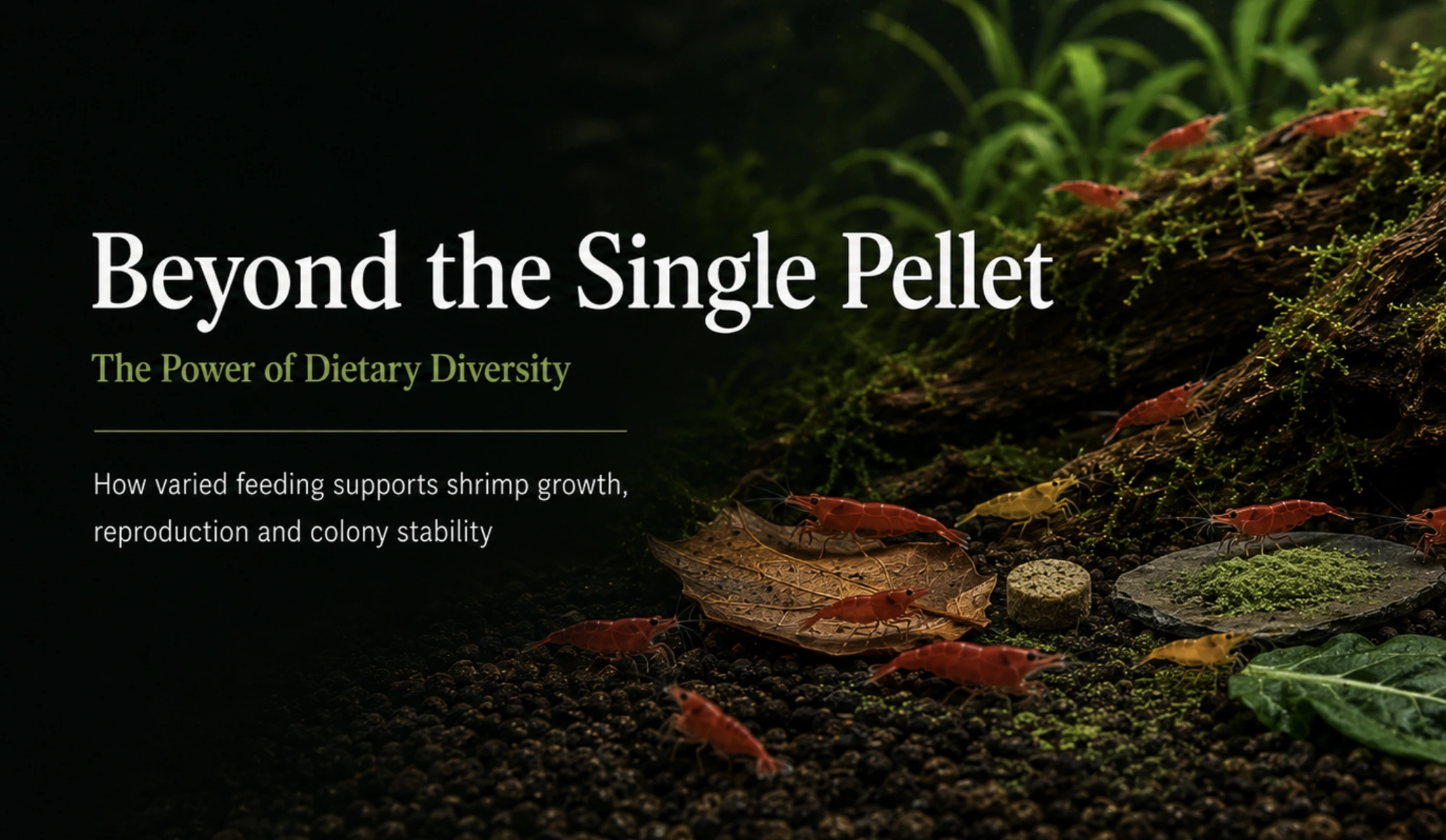
Aquarium animals are often fed according to a simple principle: find one food they accept, then continue feeding it. This approach can work, especially when the food is well formulated and provides sufficient protein, energy, lipids, vitamins, minerals and pigments.
However, predictability is not the same as biological completeness. In natural aquatic environments, shrimp do not encounter one chemically uniform pellet delivered to the same place every day. They graze across a changing food web composed of algae, bacteria, fungi, protozoa, decomposing plant material, detritus and small animal matter.
A newly fallen leaf is chemically different from the same leaf after several weeks of microbial decomposition. A juvenile feeding inside moss experiences a different nutritional environment from an adult feeding on an exposed pellet.
The natural diet of a shrimp is therefore not one ingredient. It is a dynamic nutritional ecosystem.
In our colonies, we attempt to reproduce some of this diversity through a rotation containing more than 20 foods. These include complete shrimp foods, Bacter AE and other biofilm-support powders, powdered juvenile foods, spirulina, vegetables, pumpkin, spinach, peas, paprika foods, Artemia sticks, concentrated protein foods, mineral foods, snowflake foods, catappa and other leaf litter.
The colonies receiving this system show very high reproductive activity and low observed mortality. That observation is meaningful, but it is not proof that dietary variety alone caused the result. Genetics, temperature, water chemistry, colony age structure, microbial maturity, stocking density and habitat complexity may also contribute.
The scientifically useful question is therefore not whether 20 foods are automatically better than one. It is whether a varied feeding system can provide nutritional and ecological functions that one food may not reliably provide alone.
The likely answer is yes, provided that the foods are complementary, the total ration remains controlled and a nutritionally complete staple anchors the rotation.
1.) Food Is Not the Same as Nutrition
Aquarists often describe diets by visible ingredients: spirulina, pumpkin, spinach, peas, paprika, Artemia or leaves. These labels are useful, but the shrimp does not physiologically require “pumpkin” or “spirulina” as categories.
It requires nutrients and functional food properties.
These include:
1.) Essential amino acids.
2.) Digestible energy.
3.) Fatty acids, phospholipids and sterols.
4.) Carotenoids and vitamins.
5.) Minerals and trace elements.
6.) Digestible and structural carbohydrates.
7.) Food particles that are physically accessible.
The food’s physical form also matters. A pellet provides a concentrated ration, a powder distributes particles across surfaces, a vegetable becomes both food and grazing substrate, and a leaf supports microbial colonisation over a much longer period.
Two foods with similar ingredients may therefore behave very differently after entering the aquarium. Their effect depends on digestibility, particle size, water stability, palatability, spatial distribution, feeding duration and which life stages can access them.
A feeding programme should be evaluated as a system rather than as a collection of product names.
2.) Nutritional Geometry: Ratios Matter
Nutrition is often discussed one nutrient at a time. A food may be described as high in protein, rich in carotenoids or fortified with minerals.
Animals, however, consume mixtures of nutrients. The biological value of one nutrient depends partly on the proportions in which other nutrients are supplied.
This idea is captured by nutritional geometry. In a simplified model, two nutrients—such as protein and carbohydrate—are represented as axes. Each food provides those nutrients in a particular ratio, creating a path through nutritional space.
The animal is assumed to have an intake target, meaning a combination of nutrient amounts and proportions that best supports its current physiological condition. If one food matches that target well, the animal may reach it simply by eating the correct quantity.
If the ratio is unsuitable, the animal faces a compromise. It may consume enough food to satisfy its protein requirement while overconsuming carbohydrate, or restrict energy intake while failing to obtain enough protein.
When complementary foods are available, an animal may move closer to its nutritional target by alternating between them.
This gives a stronger explanation for dietary variety:
Different foods can provide different routes towards nutritional balance.
The model must still be applied cautiously. A precise protein, carbohydrate and lipid intake target has not been established for Neocaridina davidi, and shrimp may not always select foods according to physiological need. Highly palatable foods may be overconsumed, dominant adults may monopolise concentrated foods and juveniles may have access only to fine particles and biofilm.
Nutritional geometry explains why ratios and combinations matter. It does not prove that shrimp can formulate a perfect diet simply because many foods are offered.
3.) The Colony Does Not Have One Nutritional Requirement
A shrimp colony contains animals in different physiological states. Newly hatched juveniles, rapidly growing subadults, adult males, non-reproductive females, females developing ovaries and ovigerous females do not necessarily require identical nutrient proportions.
Nutritional needs may change with:
1.) Body size and growth rate.
2.) Sex and age.
3.) Moult stage.
4.) Reproductive condition.
5.) Temperature and stress.
6.) Previous nutrition and health.
A recently hatched juvenile may benefit most from fine, dispersed food and mature biofilm. A female producing eggs may require greater access to protein, lipids and carotenoids. A recently moulted shrimp may remain hidden and fail to reach a concentrated feeding site.
One food may be adequate on average while being poorly matched to particular life stages.
Dietary diversity can therefore be useful because it creates several nutritional pathways within the same colony. Powdered food reaches small juveniles, concentrated foods support adults, biofilm provides continuous grazing and complete foods supply a dependable micronutrient baseline.
This is not only chemical diversity. It is also access diversity.
4.) Macronutrients Interact
Protein, lipid and carbohydrate should not be treated as independent ingredients.
Protein supplies amino acids for muscle, enzymes, reproductive tissues and other biological structures. However, amino acids can also be oxidised for energy. If insufficient non-protein energy is available, some dietary protein may be used as fuel rather than retained for growth or reproduction.
Adding more lipid or carbohydrate can spare protein under some conditions, but not indefinitely. An unsuitable energy balance may reduce feed intake, increase tissue fat or alter digestive physiology.
The effect of a protein food therefore depends on more than crude protein percentage. It depends on:
1.) Amino-acid composition.
2.) Digestibility.
3.) The amount consumed.
4.) Available energy from other nutrients.
5.) The shrimp’s life stage and reproductive condition.
6.) What else is fed during the same period.
A high-protein food can be useful during growth and ovarian development, but excess protein does not automatically improve performance. Amino acids that are not retained must be metabolised, and their nitrogen eventually enters the aquarium through excretion, faeces and decomposition.
Protein retained in growth and eggs supports the colony. Protein left uneaten or metabolised unnecessarily becomes part of the nitrogen load.
5.) Protein Quality Is More Important Than the Label
A food containing 45% crude protein is not automatically superior to one containing 35%.
Crude protein estimates nitrogen-containing material. It does not show whether the amino-acid profile matches the animal’s requirements or whether the protein is efficiently digested.
Two protein sources can have similar crude percentages while differing substantially in amino-acid availability. If one essential amino acid is relatively deficient, the remaining amino acids cannot be used as efficiently for new tissue.
A useful analogy is construction. An excess of bricks cannot compensate for the absence of structural beams.
This is one reason rotations containing spirulina, soy-derived ingredients, Artemia and other animal-derived proteins may be useful. Their amino-acid profiles and digestibilities are not identical, so one source may partly compensate for the limitations of another.
However, variety becomes useful only when it improves balance. Several similar protein foods may simply duplicate the same nutritional load.
6.) More Is Not Always Better
Nutrition usually follows a non-linear response.
At low intake, a nutrient may be limiting. Increasing it improves performance. Beyond an adequate range, additional intake may provide little benefit, and at still higher levels it may become wasteful or harmful.
This principle applies to:
1.) Protein.
2.) Lipids.
3.) Carotenoids.
4.) Vitamins.
5.) Minerals.
6.) Plant extracts.
7.) Microbial additives.
Foods marketed as “protein boosting,” “mineral boosting” or “immune boosting” should therefore not be interpreted as ingredients that should be maximised.
The correct question is:
What amount corrects a limitation without creating another imbalance?
A rotation may reduce the risk of chronic excess from one highly concentrated food, but only if each new food replaces part of the previous ration. If every product becomes an additional meal, diversity quickly becomes overfeeding.
Dietary variety should change composition more than it changes total nutrient input.
7.) Nutritional Complementarity and Redundancy
Different foods are most valuable when their limitations differ.
A complete pellet may provide vitamins and minerals but offer only a brief feeding period. Leaf litter provides poor concentrated nutrition but excellent long-term microbial habitat. Spirulina supplies pigments and a distinct protein source, while Artemia-based foods may broaden the amino-acid and lipid profile.
Powders may reach juveniles but are difficult to remove once dispersed. Vegetables provide plant compounds and texture but should not be treated as complete diets.
Together, these foods can create nutritional complementarity, where the strength of one compensates for the weakness of another.
A varied rotation can also provide redundancy. If one food is poorly accepted, its vitamin content degrades or its particles are too large for juveniles, another food may partly compensate.
This resembles functional redundancy in an ecosystem: several components perform overlapping functions, so the system does not depend entirely on one.
Redundancy should not be confused with unnecessary duplication. Three similar mineral foods do not necessarily improve a tank whose mineral supply is already adequate. Several concentrated protein products may simply increase nitrogen loading.
The meaningful measure is not product count. It is functional coverage.
8.) A Complete Food Should Anchor the Rotation
Fresh vegetables, leaf litter and individual supplements vary in composition. Their nutritional value depends on variety, growing conditions, maturity, processing, drying and storage.
A high-quality complete shrimp food can therefore act as the nutritional anchor of the rotation. It provides a recurring baseline of protein, energy, lipids, vitamins, minerals and trace nutrients.
This avoids two extremes.
The first is feeding one pellet indefinitely and assuming that every life stage and reproductive state has identical needs. The second is feeding a large collection of vegetables, leaves and supplements without any dependable nutritional baseline.
A complete food reduces the risk of chronic deficiency. Supplementary foods then broaden the diet around that baseline.
9.) Maternal Provisioning: Feeding the Next Generation
Reproduction is not simply the production of eggs. It is the transfer of biological resources from one generation to the next.
In Neocaridina davidi, embryos develop inside eggs carried beneath the female’s abdomen. Before hatching, the embryo cannot select among spirulina, leaves or protein sticks. Its nutritional environment is the egg.
That egg was constructed from resources accumulated and allocated by the mother.
This process is called maternal provisioning. Females transfer proteins, lipids, carotenoids, minerals, vitamins and energy reserves into developing eggs.
The female must divide available resources among maintenance, growth, moulting, repair, current reproduction and future reproduction. This creates a resource-allocation trade-off.
Research following N. davidi through successive spawnings found that later eggs contained less lipid and energy, while reproductive females also ended at lower body weight. Repeated reproduction therefore drew on resources that might otherwise have supported somatic growth.
A diet that supports one successful brood may not necessarily support the fourth, fifth or sixth brood equally well. A varied rotation may help by reducing the probability that the same nutrient remains chronically limiting across repeated reproductive cycles.
10.) Egg Number Is Not the Same as Offspring Quality
Aquarists often evaluate reproduction by counting berried females or visible eggs. These are useful measurements, but they are incomplete.
Different diets can produce similar egg numbers while altering egg composition.
In a controlled N. davidi study, several commercial diets produced no detected difference in egg size or realised fecundity. However, egg carotenoid concentrations differed, and juveniles from one maternal treatment showed fewer visible lipid droplets despite similar initial body weight.
This demonstrates an important distinction:
Reproductive output and maternal provisioning can respond differently to the same diet.
Two females may produce similar numbers of eggs, yet their offspring may differ in energy reserves, pigment deposition, later growth or tolerance of temporary food shortage.
A breeding diet should therefore be evaluated through more than the number of eggs produced. Hatching, juvenile survival, growth and later performance also matter.
11.) Carotenoids Have Functions Beyond Colour
Carotenoids are usually discussed in ornamental shrimp because they affect visible colouration. However, maternal studies show that dietary carotenoids can also be deposited into eggs.
Females receiving diets with higher carotenoid concentrations have produced eggs containing more carotenoids, even when basic fecundity measurements did not differ.
This provides a plausible role for spirulina, paprika-based foods and carotenoid-rich vegetables within a breeding rotation. Their value may extend beyond brighter adult colour.
The effect still depends on carotenoid type, absorption, processing and dose. The pigment concentration in an ingredient is not identical to the amount ultimately deposited into shrimp tissue.
Paprika foods should therefore be treated as targeted pigment sources, not as guaranteed reproductive stimulants.
12.) Spirulina Has Direct Evidence, but It Is Not a Complete Diet
Spirulina is one of the better-supported supplementary foods for Neocaridina.
In a long-term study, shrimp were fed formulated diets containing several inclusion levels of Arthrospira platensis over multiple successive spawnings. Higher spirulina treatments were associated with improvements in female survival, growth, fecundity and hatching under some conditions.
The response was not uniform. It varied with dose, trait and spawning event.
This is more informative than calling spirulina a superfood. It suggests that spirulina can be a meaningful component of a balanced diet, but its effect depends on how much is included and what else the diet contains.
The successful experimental diets were complete formulations in which spirulina replaced part of the ration. They do not show that unlimited spirulina powder added to an aquarium will produce the same outcome.
13.) Lipid Quality Matters for Egg Construction
Lipids are not one uniform nutrient.
Some provide concentrated energy, phospholipids form cell membranes, sterols contribute to membrane structure and physiological pathways, and different fatty acids perform different roles.
During ovarian development, females transfer substantial lipid resources into eggs. The source and class of dietary lipids may therefore influence maternal condition, egg composition and juvenile reserves.
Studies in other cultured shrimp have shown that different phospholipid sources can produce different growth, physiological and microbiome responses even when they all supply dietary lipid.
These results should not be transferred numerically to Neocaridina, but they support the broader principle that total fat percentage does not fully describe lipid quality.
Artemia-based foods, complete diets, algae and plant ingredients may therefore contribute different lipid fractions rather than simply adding “more fat.”
14.) Juveniles Occupy a Different Feeding Environment
A colony may receive abundant food while its smallest juveniles remain nutritionally limited.
Large pellets may be excellent foods for adults but inaccessible to newborn shrimp. Adults may crowd around feeding dishes, while juveniles remain inside moss or leaf litter to avoid exposure.
This makes juvenile nutrition partly a spatial problem.
Powdered foods can help because they settle across moss, leaves, wood, substrate, filter surfaces and existing biofilm. Instead of one concentrated feeding site, they create many small feeding locations.
However, powder is difficult to recover once added. Excess particles may settle into inaccessible areas and increase microbial respiration rather than feeding shrimp directly.
The useful dose is often much smaller than the amount needed to create a visible cloud.
15.) Biofilm Is a Major Food Source
Biofilm is often described as a supplementary snack, but for Neocaridina it can support growth, juvenile survival and even completion of the life cycle.
A mature biofilm may contain algae, bacteria, fungi, protozoa, diatoms and trapped organic particles. It is therefore a mixed food resource rather than one organism.
Its composition varies with light, water chemistry, surface type, age, flow, organic input and grazing pressure. One aquarium’s biofilm may be nutritionally very different from another’s.
Nevertheless, the evidence supports an important conclusion: the microbial layer is not incidental. It can function as a major part of the shrimp’s diet.
This gives biological plausibility to leaf litter, mature wood, moss, sponge filters, powdered juvenile foods and biofilm-support products. Their value may lie partly in creating or enriching a grazing surface rather than feeding shrimp only as intact particles.
16.) Biofilm-Support Powders Need Careful Dosing
Products such as Bacter AE are commonly described as promoting biofilm and supporting juveniles.
The broad mechanism is plausible. A finely dispersed substrate can settle across surfaces, feed microorganisms and create feeding opportunities that are more widely distributed than a pellet.
However, evidence that biofilm is valuable does not directly validate every commercial product claim.
A small amount of powder may support microbial food production. A large amount may increase suspended bacterial growth, oxygen demand and organic accumulation.
The scientifically defensible claim is:
Biofilm-support powders may increase microbial and juvenile food availability, but their value depends strongly on dosage and the existing ecology of the aquarium.
The success of biofilm does not justify unlimited dosing of products intended to create it.
17.) Food Shapes the Gut Microbiome
The shrimp digestive tract contains microorganisms that are exposed to the same nutrients entering the gut.
Food therefore feeds two interacting systems:
1.) The shrimp.
2.) The shrimp-associated microbiota.
Protein-rich foods supply peptides and nitrogenous compounds. Plant materials supply carbohydrates and structural substrates. Yeast products provide microbial cells and cell-wall compounds, while different lipid sources alter the chemical environment inside the gut.
Dietary studies in other shrimp species show that feed composition can alter intestinal microbial communities alongside physiological measurements.
This supports the conclusion that diet selects microbial communities. It does not show that more dietary ingredients automatically produce a healthier microbiome.
18.) Microbial Diversity Is Not Automatically Beneficial
A “diverse microbiome” is often treated as a synonym for a healthy microbiome. This is too simple.
A microbial community should be evaluated by function, stability and interaction with the host rather than species count alone. A highly diverse community may contain opportunists or pathogens, while a less diverse community may be stable and well adapted to a particular host and diet.
Research on white-faeces syndrome in Pacific white shrimp has shown that altered intestinal communities can contribute causally to disease. This confirms that the microbiome can influence shrimp health.
It does not identify one universally healthy microbial composition for all shrimp, diets and aquarium conditions.
The important question is not merely how many microbial types are present. It is what they are doing.
19.) The Aquarium–Biofilm–Gut Connection
Shrimp continuously ingest microorganisms from surfaces, water and food.
Diet can therefore influence the microbiome through several pathways:
1.) It changes substrates inside the gut.
2.) It introduces food-associated microorganisms.
3.) Uneaten food alters surface and water microbiota.
4.) Shrimp later consume those altered communities while grazing.
The feeding system therefore connects food, aquarium microbiota, gut microbiota and shrimp physiology.
This is one reason leaves, powders and slow foods may have effects beyond their measured nutrient composition. They change the microbial environment from which future meals are assembled.
Small, varied inputs may support several microbial pathways. Large, rapidly changing organic inputs may instead create repeated blooms and crashes.
The important distinction is controlled resource heterogeneity rather than random disturbance.
20.) What the Main Food Categories Contribute
Different foods in the rotation can be understood by function.
1.) Complete foods
These provide the nutritional baseline. They reduce the risk that the colony depends entirely on variable vegetables, leaves and supplements.
2.) Spirulina
Spirulina contributes protein, pigments and bioactive compounds. It has direct reproductive evidence in Neocaridina, but it should remain a component of a complete diet rather than becoming the entire diet.
3.) Paprika-based foods
These are primarily useful as carotenoid sources. They may contribute to adult pigmentation and maternal transfer of carotenoids into eggs, but their value depends on formulation and dose.
4.) Pumpkin, spinach and peas
Vegetables broaden plant compounds, textures, pigments and microbial substrates. They should be treated as complementary foods rather than complete rations.
Fresh and dried forms are not equivalent. Drying removes water and concentrates dry matter, so a small dried portion may add more organic material than its visible size suggests.
5.) Artemia and protein sticks
These broaden amino-acid and lipid sources and may be useful during growth and reproduction. They are concentrated foods and can create substantial waste when overfed.
6.) Snowflake foods
Their main advantage may be temporal. They soften slowly and remain available over a longer grazing period, but slow disappearance does not prove full consumption.
7.) Leaf litter
Leaves provide food, habitat, organic carbon and microbial grazing surfaces. Their nutritional value changes as they decompose and become colonised by microorganisms.
8.) Mineral foods
These may contribute to the dietary mineral pool, but they must be considered alongside water hardness, pH and ion balance. More mineral food cannot correct fundamentally unsuitable water chemistry.
9.) Foods marketed for immune support
These should be evaluated by their ingredients and measured effects rather than marketing language. A food may influence one immune-associated biomarker without necessarily improving real disease survival.
21.) Rotation and Mixing Serve Different Purposes
A rotation exposes the colony to different foods at different times. This makes it easier to observe acceptance, disappearance, waste production and which life stages reach each food.
Mixing supplies several foods in the same feeding event. This can be useful when distributing spirulina with juvenile powder or adding a small amount of protein food to a plant-based ration.
However, mixtures make actual intake difficult to interpret. The aquarist knows what entered the aquarium but not what each shrimp consumed.
Highly attractive particles may be eaten first while less palatable components remain.
A functional feeding programme can use both strategies. Rotation preserves observable feeding events, while mixing is useful when simultaneous nutrient and particle distribution has a defined purpose.
22.) Why Our Broad Rotation May Be Working
The performance of our colonies probably does not result from one ingredient.
The rotation may work because several pathways are supported at the same time:
1.) Complete foods provide a dependable nutritional baseline.
2.) Spirulina, paprika and vegetables broaden pigment and plant-compound exposure.
3.) Artemia and protein foods broaden amino-acid and lipid sources.
4.) Powders distribute food to juvenile habitat.
5.) Leaf litter and biofilm provide continuous microbial grazing.
6.) Snowflake foods extend feeding across time.
7.) Mineral foods supplement one part of the mineral system.
8.) Different food forms reduce dependence on one feeding site.
Some foods feed shrimp directly. Others feed the microbial ecosystem that supports them later.
The result is not simply more food. It is a multi-pathway nutritional system.
23.) Why the Rotation May Support Reproduction
High reproductive output requires several processes to succeed repeatedly. Females must maintain body condition, develop ovaries, provision eggs, carry embryos, recover and reproduce again.
Protein and energy support maintenance and ovarian tissue. Lipids and carotenoids can be transferred into eggs. Biofilm and powders support juveniles after hatching, while leaf litter provides longer-term food availability.
Dietary redundancy may also reduce the chance that repeated reproduction exhausts one specific nutrient supply.
This provides a plausible explanation for high reproductive performance, but it remains a hypothesis. The feeding system has not been isolated experimentally from genetics, temperature, habitat and microbial maturity.
24.) Why the Rotation May Support Low Mortality
Low mortality may reflect several interacting factors: a complete-food baseline, reduced micronutrient risk, continuous grazing, food distribution across life stages and a mature microbial environment.
However, mortality is difficult to measure accurately in dense shrimp colonies. Tiny juveniles and recently dead individuals may be difficult to detect, and carcasses may be scavenged rapidly.
Strong population growth suggests that survival is good enough to support recruitment. It does not necessarily reveal the exact mortality rate.
A rigorous assessment would require defined cohorts, starting numbers and repeated measurements of egg production, hatching and juvenile survival.
25.) The Main Risk Is Overfeeding
The largest danger of dietary variety is that each food becomes an additional ration rather than a replacement.
If a colony previously received one pellet and later receives a pellet, powder, protein food, vegetables and leaf litter in the same individual quantities, both diversity and total nutrient input have increased.
This makes it impossible to separate the effect of variety from the effect of simply feeding more.
It also raises:
1.) Microbial oxygen demand.
2.) Nitrogen excretion.
3.) Uneaten organic accumulation.
4.) Nitrate and phosphate production.
5.) The probability of bacterial blooms.
6.) The risk of local oxygen depletion.
The composition of the rotation can vary widely. Total input must remain within the processing capacity of the shrimp colony and the microbial ecosystem.
Every new food should usually replace part of another ration rather than being added on top.
26.) Our Observation Is Evidence, but Not Proof
The high reproduction and low observed mortality of our colonies support the hypothesis that the feeding programme is effective.
They do not isolate the independent contribution of dietary diversity.
The outcome may also be influenced by:
1.) Total food quantity.
2.) The complete-food baseline.
3.) Biofilm maturity.
4.) Leaf litter.
5.) Stable water chemistry.
6.) Habitat complexity.
7.) Temperature.
8.) Genetics.
9.) Low pathogen pressure.
10.) Adaptation to our management system.
These factors may interact. A diverse rotation may perform well in a mature, biofilm-rich aquarium while creating excess waste in a newer or sparsely structured tank.
The strongest defensible conclusion is:
Our colony performance is consistent with the hypothesis that a diverse, complementary and controlled feeding system supports reproduction and survival, but dietary diversity has not been isolated as the sole cause.
27.) Designing the Rotation by Function
A practical rotation should be organised by biological role rather than product count.
1.) Nutritional anchor: Use a high-quality complete shrimp food regularly.
2.) Algal and microbial ingredients: Include spirulina and carefully dosed biofilm-support powders.
3.) Plant diversity: Use pumpkin, spinach, peas and similar foods as complementary plant inputs.
4.) Animal-derived nutrition: Offer Artemia and concentrated protein foods intermittently.
5.) Pigment sources: Use spirulina, paprika and other carotenoid-rich ingredients.
6.) Long-duration grazing: Maintain leaf litter and slow-softening foods.
7.) Juvenile distribution: Apply very small quantities of fine powder across existing grazing surfaces.
8.) Mineral support: Use mineral foods only in the context of suitable water chemistry.
9.) Functional additives: Evaluate immune- or antioxidant-support foods by their actual ingredients and evidence.
The rotation should then respond to the colony. A large juvenile cohort may justify more finely distributed food, while repeated reproduction may justify greater attention to protein, lipid and carotenoid sources.
Accumulating food should reduce the next ration. Population growth may require a gradual increase, while selling or moving shrimp should reduce total feeding.
The colony—not the calendar—should determine the dose.
Conclusion: Feeding a Nutritional Ecosystem
A shrimp diet is not simply the pellet placed into the aquarium.
It includes the powder, vegetable, leaf, biofilm, algae, microorganisms, detritus and fine particles trapped among moss and substrate.
One complete food may be capable of maintaining a colony. A diverse and controlled feeding programme can provide something broader: nutritional complementarity, dietary redundancy, maternal provisioning, juvenile access and support for microbial food production.
But diversity is not a substitute for balance.
Twenty foods are not automatically better than one. They become useful when each performs a distinct function, a complete diet anchors the system and total nutrient input remains within the processing capacity of the aquarium.
When one food is limited, another may compensate. When adults dominate one feeding site, powder and biofilm may still reach juveniles. When a female consumes carotenoids and lipids, some of those resources may enter the next generation through her eggs.
A single food asks one formulation to satisfy every life stage, moult stage and reproductive condition. A functional rotation distributes those demands across an entire nutritional ecosystem.
The strongest feeding programme is not necessarily the one containing the most foods.
It is the one in which every food has a biological purpose.
References
Alam, M.I. et al. (2021). Synergistic effects of mangrove leaf litter and supplemental feed on water quality, growth and survival of shrimp Penaeus monodon postlarvae. Aquaculture, 545, 737237.
Frías-Gómez, S.A. et al. (2023). Effect of dietary protein, lipid and carbohydrate ratio on growth, digestive and antioxidant enzyme activity of prawn Macrobrachium acanthurus postlarvae. Aquaculture Reports, 30, 101578.
Guo, Y. et al. (2022). Effects of dietary yeast culture on health status in the digestive tract of juvenile Pacific white shrimp Litopenaeus vannamei. Fish and Shellfish Immunology Reports, 3, 100065.
Huang, Z. et al. (2020). Microecological Koch’s postulates reveal that intestinal microbiota dysbiosis contributes to shrimp white-faeces syndrome. Microbiome, 8, 32.
Li, X. et al. (2022). Evaluation of six novel protein sources on apparent digestibility in Pacific white shrimp, Litopenaeus vannamei. Aquaculture Nutrition, 2022, 8225273.
Liang, X. et al. (2022). Growth, health and gut microbiota of female Pacific white shrimp, Litopenaeus vannamei, broodstock fed different phospholipid sources. Antioxidants, 11, 1143.
Namaei Kohal, M. et al. (2018). Effects of dietary incorporation of Arthrospira platensis meal on growth, survival, body composition and reproductive performance of red cherry shrimp Neocaridina davidi over successive spawnings. Journal of Applied Phycology, 30, 431–443.
Pantaleão, J.A.F. et al. (2015). Nutritional vulnerability in early stages of the freshwater ornamental red cherry shrimp Neocaridina davidi. Journal of Crustacean Biology, 35, 676–681.
Raubenheimer, D. & Simpson, S.J. (1999). Integrating nutrition: a geometrical approach. Entomologia Experimentalis et Applicata, 91, 67–82.
Sganga, D.E. & López Greco, L.S. (2020). Effect of commercial diets on female reproductive performance and offspring quality in the red cherry shrimp Neocaridina davidi. Aquaculture Research, 51, 5029–5039.
Tomas, A.L. et al. (2020). Effect of diets on carotenoid content, body coloration, biochemical composition and spermatophore quality in the red cherry shrimp Neocaridina davidi. Aquaculture Nutrition, 26, 1198–1210.
Tropea, C. & López Greco, L.S. (2015). Female growth and offspring quality over successive spawnings in a caridean shrimp Neocaridina davidi with direct development. The Biological Bulletin, 229, 243–254.
Viau, V.E. et al. (2020). Breeding and life cycle of the ornamental freshwater shrimp Neocaridina davidi in a biofilm-based culture system. Aquaculture Research, 51, 4787–4799.
Comments (0)
Want to leave a comment? Sign in to your account to join the discussion.
Don't have an account? Create one