Introduction: From the Labs of UCC to the Home Aquarium
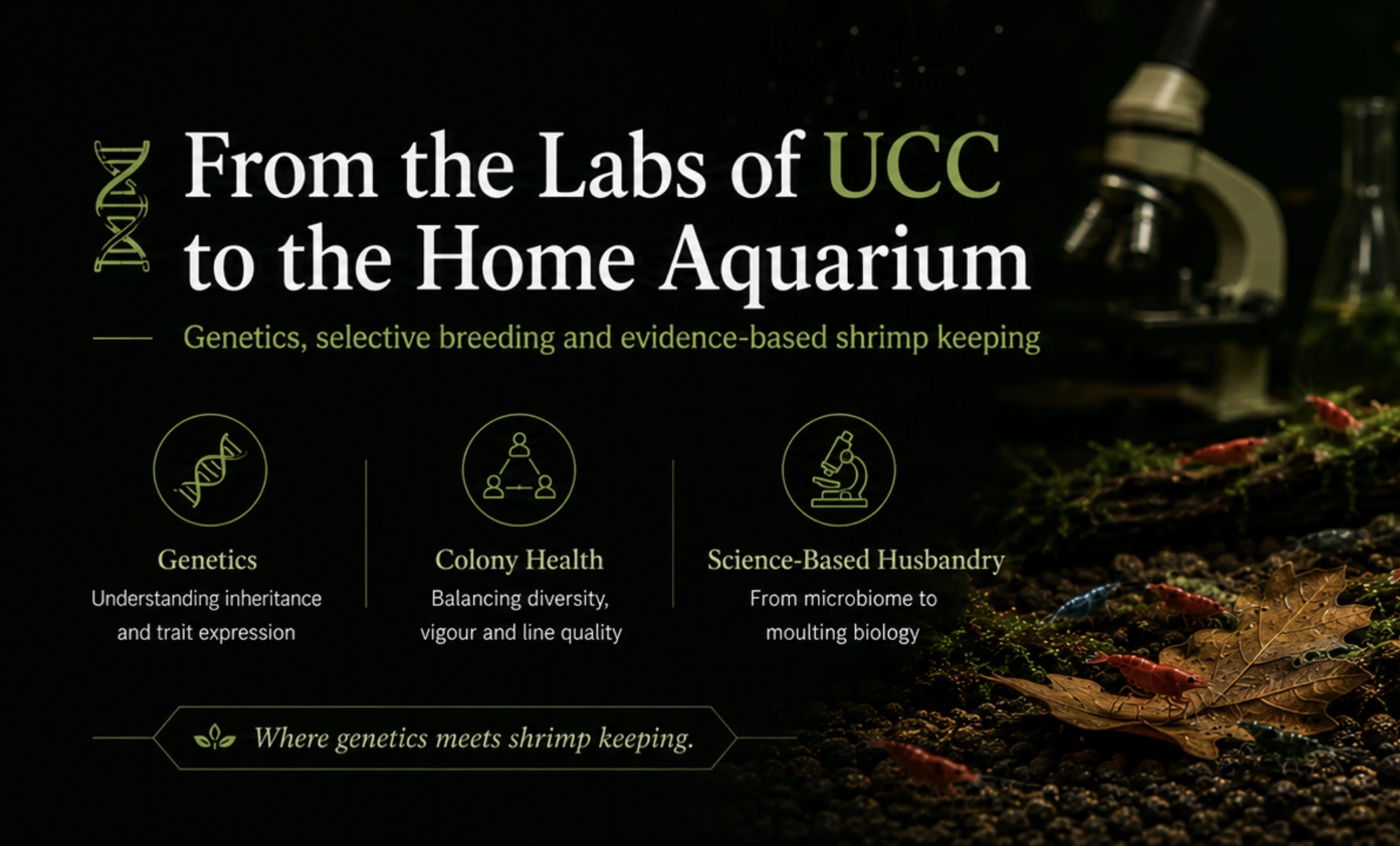
Our journey into shrimp keeping did not begin in a pet shop. It began in the lecture halls and laboratories of University College Cork, where we studied Genetics through the CK405 programme.
There, we learned how variation arises, how traits are inherited, how populations change across generations and how environmental conditions influence the expression of a phenotype. Those ideas are usually discussed in relation to research organisms, agriculture, medicine or biotechnology, but we increasingly found ourselves applying the same principles to the shrimp colonies in our aquariums.
What many hobbyists see as colour grades, patterns and breeding lines, we see as the visible outcome of genetics, development and environment interacting over time.
Labels such as Painted Fire Red, Blue Dream or Blue Bolt are useful shorthand within the hobby, but they are not genes. They describe phenotypes: traits we can observe. Behind those visible traits are inherited variants, polygenic effects, developmental variation, environmental influences and the selection decisions made by breeders across generations.
Our aquariums gradually became more than displays. They became living populations.
The Geneticist’s Perspective
A background in genetics changes the questions we ask.
We do not simply ask which shrimp looks best. We ask how consistently the trait is inherited, how much variation remains within the line, whether the phenotype is stable across environments and what may be lost when selection becomes too narrow.
This influences how we manage our colonies in several ways.
1.) Selective breeding with a defined objective
Selective breeding is more than retaining the most visually attractive individuals. It involves deciding which traits matter, how they will be measured and which animals should contribute to the next generation.
Some traits may be influenced strongly by a small number of loci. Others, including colour intensity, growth, fertility and behaviour, may be polygenic, meaning that many genetic variants contribute to the final phenotype.
Environmental conditions also matter. Nutrition, age, background colour, stress, water chemistry and reproductive state can all alter how a trait is expressed.
A shrimp that appears darker in one aquarium may not carry a genetically superior colour phenotype. It may simply be expressing the same genotype differently under another environment.
For this reason, stabilising a line requires repeated selection across generations rather than one attractive parent.
2.) Genetic diversity and colony health
Closed aquarium populations can lose genetic diversity over time, particularly when only a small number of animals contribute offspring.
This does not mean that every degree of inbreeding immediately produces unhealthy shrimp. Many selected lines are created through related matings. The concern is that prolonged breeding from a narrow group may increase homozygosity and expose deleterious recessive variants.
It can also reduce the genetic variation available for future selection.
The visible population size is not always the same as the genetically effective population size. A tank may contain hundreds of shrimp while most of the next generation descends from only a few females or one highly successful family.
We therefore consider more than colour and pattern. Fertility, growth, survival, moulting success and long-term colony vigour are also part of the breeding phenotype.
3.) Phenotype is produced by genes and environment
Genotype describes the genetic information carried by an organism. Phenotype describes the observable outcome produced by that genotype within a particular environment.
In shrimp, colour, growth, reproductive performance and survival are not determined by genetics alone. They are influenced by diet, microbial maturity, temperature, mineral availability, social density and many other environmental factors.
This is why good breeding and good husbandry cannot be separated.
A genetically promising shrimp cannot express its full potential in an unstable or nutritionally limited aquarium. Likewise, excellent husbandry cannot create a heritable trait that is absent from the breeding population.
The breeder manages both inheritance and environment.
Science-Based Husbandry
Genetics may be our academic foundation, but successful shrimp keeping requires a broader biological perspective.
An aquarium is a microbial ecosystem, a chemical environment and a managed population at the same time. Water quality, nutrition, habitat structure and colony genetics interact continuously.
Our approach therefore draws on several scientific fields.
1.) Microbial ecology
The nitrogen cycle is only one part of aquarium maturation. A mature tank contains bacteria, archaea, fungi, algae, protozoa and other organisms living within biofilms and sediments.
These communities process waste, recycle nutrients and form part of the shrimp’s natural grazing environment. In many cases, the food web growing on a leaf, sponge filter or piece of wood is as important as the food placed into the tank by the keeper.
2.) Biochemistry and nutrition
Shrimp require more than crude protein and calories. Amino-acid balance, lipid quality, carotenoids, vitamins, minerals and digestibility all influence growth and reproduction.
Maternal nutrition can also affect egg composition and juvenile quality. The food consumed by one generation may therefore influence the condition of the next before the juveniles hatch.
3.) Physiology and water chemistry
Moulting, osmoregulation and exoskeleton formation depend on the interaction between dietary minerals and water chemistry. Calcium, magnesium, alkalinity, pH and conductivity cannot be considered independently.
Shrimp are also exposed continuously to dissolved substances through their gills and body surfaces. This is why contaminants, unstable parameters and poorly characterised materials can affect them before obvious symptoms appear.
Our goal is not to replace experience with theory. It is to understand why an observation occurs and whether it is likely to apply beyond one aquarium.
Bridging Science and the Hobby
Just Keep Shrimping was created to bridge the gap between scientific knowledge and practical aquarium keeping.
The hobby contains an enormous amount of valuable experience. Many successful methods were developed through years of careful observation rather than formal experiments.
However, anecdotal success does not always reveal the mechanism behind it. A method may work because of one hidden variable, several interacting variables or conditions unique to a particular aquarium.
We want to examine those claims more carefully.
That means asking:
1.) What biological mechanism could explain the observation?
2.) Is there direct evidence in Neocaridina or related crustaceans?
3.) Are we applying results from aquaculture, ecology or laboratory systems to a home aquarium?
4.) Which conclusions are well established, and which remain plausible hypotheses?
5.) How can the science be translated into practical decisions?
The aim is not to make shrimp keeping unnecessarily complicated. It is to make complex biology understandable and useful.
What You Can Expect from This Blog
The articles on Just Keep Shrimping are written for hobbyists, but they are shaped by scientific reasoning.
We explore topics such as:
1.) Selective breeding and line stabilisation.
2.) Genetic diversity, inbreeding and effective population size.
3.) Aquarium microbiomes and biofilm ecology.
4.) Nutrition, maternal provisioning and juvenile development.
5.) Habitat enrichment and behavioural biology.
6.) Predator–prey relationships in community tanks.
7.) Water chemistry, mineral availability and moulting.
8.) Material safety, toxicity and equipment failure risk.
Where direct evidence is available, we use it. Where aquarium-specific evidence is limited, we explain the uncertainty rather than presenting extrapolation as fact.
Science does not always provide a simple answer, but it provides a better way to evaluate competing answers.
Welcome to the Colony
Whether you are setting up your first shrimp aquarium or working to stabilise a rare colour line, the same biological principles apply.
Every colony contains genetic variation. Every aquarium creates selection pressures. Every management decision influences which animals survive, reproduce and contribute to the next generation.
We are not interested only in producing attractive shrimp. We want to understand how healthy, stable and genetically valuable colonies are built.
Just Keep Shrimping is where our scientific training and our interest in aquariums meet. It is a place to examine the biology behind the hobby and turn it into practical, evidence-based husbandry.
Welcome to the colony.
Let’s grow something beautiful—and understand why it works.
Comments (0)
Want to leave a comment? Sign in to your account to join the discussion.
Don't have an account? Create one