Beyond Clean Water: How Habitat Enrichment Shapes Aquarium Behaviour, Survival and Reproduction
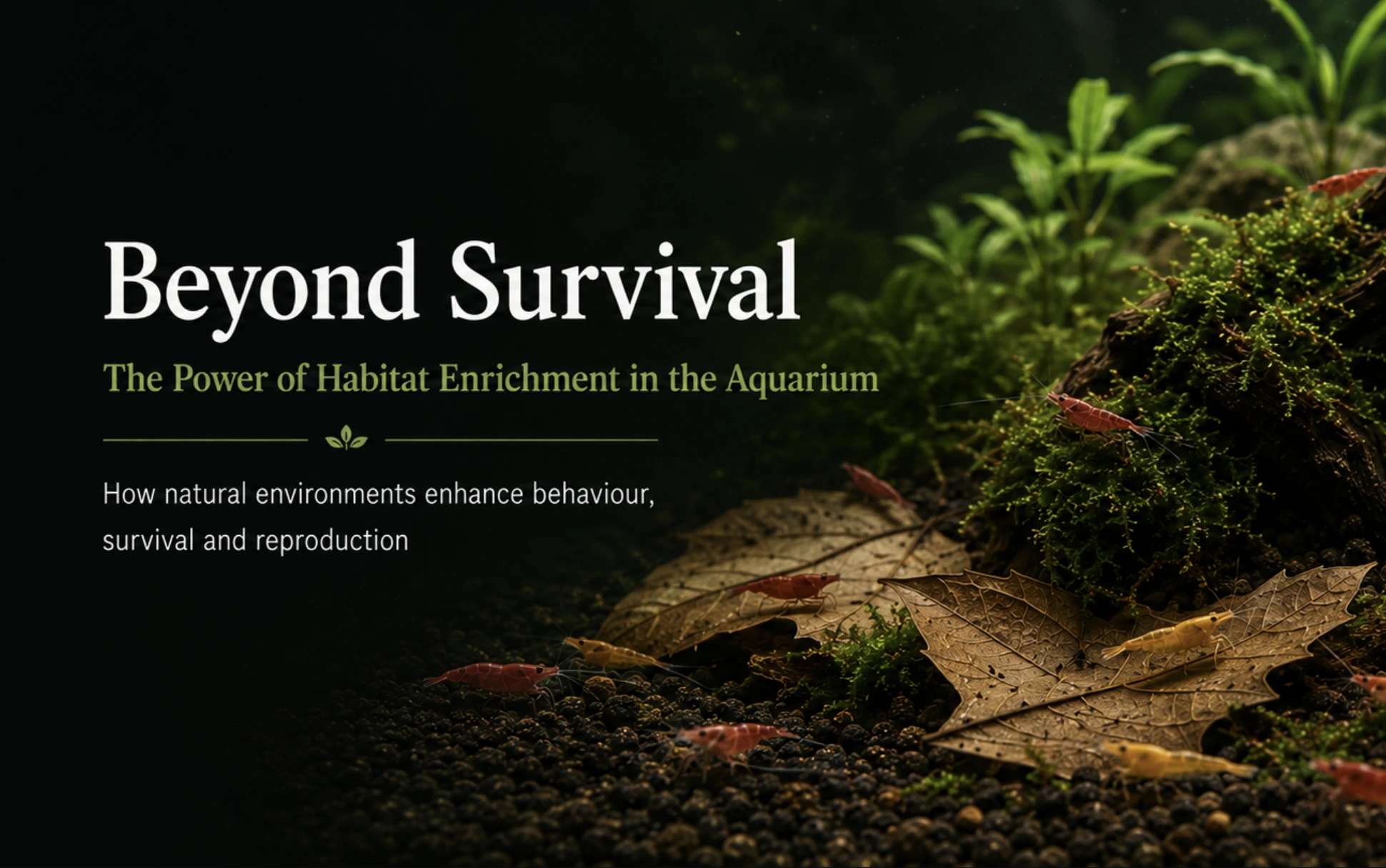
Aquarium care is often evaluated through chemistry.
Is ammonia undetectable?
Is the temperature correct?
Is the pH stable?
Are the animals eating and growing?
These measurements are essential. An aquarium with unsuitable water chemistry cannot provide acceptable conditions for its inhabitants. However, suitable water parameters do not automatically mean that an aquarium is a biologically complete habitat.
An animal can survive in an environment that permits only a small fraction of its normal behaviour.
A fish may eat while having nowhere to hide. A shrimp may grow while lacking complex surfaces on which to forage. A territorial species may remain alive while being unable to escape visual contact with a dominant individual. A bottom-feeding fish may receive sufficient nutrition while being unable to sift, dig or search for it.
This creates an important distinction:
Survival tells us that an aquarium is tolerable.
Behaviour helps tell us whether it is functional.
A naturalistic aquarium should therefore not be viewed simply as decoration. When designed around the biology of its inhabitants, habitat structure can alter how animals forage, explore, avoid threats, interact socially, reproduce and care for their offspring.
This is the purpose of habitat enrichment.
Environmental enrichment is the deliberate provision of biologically relevant opportunities. It allows an animal to perform behaviours for which its sensory systems, nervous system and body have evolved.
The aquarium becomes more than a volume of chemically suitable water.
It becomes a habitat.
1. Evolution Does Not Stop at the Aquarium Glass
Every animal carries an evolutionary history into captivity.
Across many generations, individuals varied in how they responded to predators, competitors, food shortages, potential mates and environmental change. When some of that variation affected survival or reproductive success, natural selection changed the frequency of the underlying traits within the population.
A small fish that rapidly moved towards vegetation after detecting a shadow may have been more likely to survive an attack.
A shrimp that remained concealed while its new exoskeleton hardened may have been less likely to be eaten after moulting.
A cave-spawning fish that selected an enclosed and defendable site may have protected more eggs.
A shoaling fish that remained near conspecifics may have reduced its individual probability of predation.
These behaviours are not performed because the animal has studied its natural history. They emerge from biological systems produced by genes, development and previous experience interacting with the current environment.
The word “instinct” is often used to describe such behaviour. It is useful in ordinary language, but it can imply that a behaviour is controlled by a single gene or expressed as a completely inflexible programme.
Behavioural phenotypes are more complex.
They may be influenced by:
Genetic variation
Developmental conditions
Maternal and parental effects
Previous experience
Learning and habituation
Age and reproductive state
Social status
The immediate physical environment
Interactions between genotype and environment
An inherited behavioural predisposition is therefore not a rigid command. It is better understood as an evolutionarily shaped probability of responding in a particular way under particular conditions.
A fish may possess a strong tendency to seek cover when threatened, but individuals can differ in how quickly they respond, which shelter they choose and how long they remain concealed.
Evolution provides the behavioural architecture.
The environment influences how that architecture is expressed.
2. Artificial Selection: When Humans Change Behavioural Distributions
Natural selection is not the only process capable of changing behaviour across generations.
When humans influence which animals reproduce, the population experiences artificial selection.
This selection can be deliberate. A breeder may choose animals for tameness, guarding ability, herding behaviour, feeding response, colour, growth, body shape or reproductive performance.
It can also be unintentional.
Animals that tolerate handling, accept prepared food and reproduce successfully in captivity are more likely to contribute descendants to captive populations. Animals that remain highly fearful, refuse artificial diets or fail to breed under captive conditions may leave fewer offspring, even when nobody consciously selects against those behaviours.
Over time, captivity itself can become a selective environment.
Dogs: selecting from existing behavioural variation
Dogs provide a familiar example.
Domestic dogs share ancestry with ancient wolf populations, although they did not descend directly from any single modern wolf population. During domestication, variation in fear of humans, human-directed social behaviour, feeding ecology and tolerance of human environments probably affected which animals could live and reproduce near people. Later breeding intensified selection for specialised behaviours such as guarding, herding, retrieving and cooperation with humans.
This should not be simplified to “humans selected all aggression out of wolves.”
Aggression is not one phenotype. Predatory behaviour, territorial aggression, defensive aggression, aggression towards unfamiliar humans and aggression towards conspecifics can differ genetically and biologically. Selection may reduce one form while retaining or increasing another.
A livestock guardian, for example, may be tolerant and protective towards livestock and familiar people while remaining highly responsive to potential threats. A herding dog expresses controlled orientation, pursuit and movement behaviour rather than simply displaying either “aggression” or “tameness.”
Selection reorganises behavioural tendencies. It does not simply switch them on or off.
The silver fox experiment
The silver fox selection experiment provides clearer evidence because the selection criterion was explicitly defined.
Foxes were bred into lines based on their behavioural responses towards humans. After more than 50 generations, tame and aggressive lines differed markedly in behaviour. Genetic analyses also identified differences in allele frequencies and brain gene expression between the selected populations.
The important result is not that researchers discovered a single gene for tameness.
They did not.
Human-directed fear and aggression are complex, polygenic (multi-gene) phenotypes. Selection changed the population by shifting the frequencies of many contributing gene variants and by altering biological pathways involved in neural and behavioural regulation.
Correlated responses to selection
Selection for one trait can also change other traits.
This occurs when traits share genetic causes or when alleles influencing different traits are statistically associated within a population. In animal breeding, this is expressed as genetic covariance or genetic correlation.
Red junglefowl selected for high or low fear of humans demonstrated that fear-related behaviour contained a heritable component. Selection for reduced fear was also associated with changes in other characteristics, although the size and direction of correlated responses varied among traits and experiments.
This principle is important in fish breeding.
A breeder may select only for rapid growth. However, if growth is genetically correlated with feeding motivation, boldness, social dominance or stress responsiveness, those behaviours may also change.
Similarly, selecting animals that reproduce reliably in bare breeding tanks may indirectly favour individuals whose reproductive behaviour is less dependent on natural substrates, vegetation or complex courtship environments.
The behaviour changes even though behaviour was not the breeder’s stated objective.
3. Artificial Selection in Fish
Fish possess heritable behavioural and physiological variation just as terrestrial animals do.
One of the clearest examples comes from rainbow trout.
Researchers developed lines selected for high or low cortisol responses following confinement stress. The lines subsequently differed not only in endocrine responsiveness but also in feeding recovery, social behaviour, locomotor responses and neurochemical activity.
This demonstrates that stress responsiveness can respond to selection.
However, cortisol should not be treated as a direct measurement of suffering or welfare. Cortisol is part of a broader physiological response, and its interpretation depends on timing, context, baseline variation and the other behavioural and physiological traits measured.
The trout study is valuable because it shows that animals can differ consistently in how their biological systems react to the same challenge, and some of that variation can be inherited.
Domestication studies in zebrafish provide another example.
Comparisons among wild-caught fish, first-generation captive fish and established laboratory strains have found differences in activity, aggression and stress-associated behaviour. However, behavioural change did not occur as one simple linear progression from “wild” to “domesticated.” Different laboratory strains also diverged from one another.
That distinction matters.
A captive population may change through:
Direct artificial selection
Unintentional selection
Founder effects
Genetic drift
Inbreeding
Developmental plasticity
Maternal effects
Learning
Differences in rearing conditions
Several of these processes can produce similar outward behaviour.
A bold laboratory fish is not automatically proof of genetic domestication.
4. Why Fish Come to the Aquarium Glass
Aquarists commonly observe fish swimming towards the glass when a person enters the room.
The fish may appear dramatically less fearful than wild individuals.
This behaviour can arise through several mechanisms.
Habituation
Repeated exposure to a harmless stimulus may reduce the response to it.
A fish that initially hides whenever a person approaches may gradually stop responding when repeated approaches are not followed by capture or injury.
Associative learning
The fish may learn that a person predicts food.
Movement near the aquarium, the opening of a lid or a particular sound can become associated with feeding. The animal then approaches because the stimulus has acquired predictive value.
Developmental plasticity
Fish raised in an environment containing frequent human activity may develop a different behavioural phenotype from fish raised with little disturbance, even without any genetic difference between them.
Genetic selection
Across generations, less fearful fish may feed more readily, grow faster or reproduce more reliably in captivity. When these differences contain an inherited component, the behavioural distribution of the population can shift.
All four mechanisms can operate simultaneously.
Therefore:
A fish approaching its keeper is evidence of behaviour, but not by itself evidence of genetic tameness.
The animal may have learned that the aquarist provides food. It may have become habituated to movement. It may have developed under conditions that favoured bold behaviour. Its population may also have experienced generations of selection for tolerance of captivity.
The observable phenotype does not reveal the mechanism on its own.
5. A Quantitative-Genetic View of Behaviour
A simplified way to describe a behavioural phenotype is:
Phenotype = genetic effects + environmental effects + genotype-by-environment interaction
This is a conceptual model rather than a complete statistical model. Real analyses may also separate additive (gene effects stack eg. multiple red colour genes produce more red colour in the animal), dominance (one gene masks the effects of another gene, eg. eye colour in shrimp black>orange) and epistatic genetic effects (change in gene expression up or down based on external stimuli: foods, light, substrate colour in shrimp eg. darker substrate induces more pigment); maternal and common-environment effects; permanent environmental effects; repeated measurements and residual variance.
The central point is that behavioural variation within a population does not come from genes or environment alone. The same genotype can produce different phenotypes in different environments. Different genotypes can also respond differently to the same environmental change. This is a genotype-by-environment interaction.
For example, adding shelter may strongly reduce exposed swimming in one genetic line, produce a moderate response in another and have little detectable effect in a third. The average effect of enrichment may therefore depend on the genetic population being studied.
The simplest form of the breeder’s equation is:
R = h²S
Where:
R is the response to selection, or the expected change in the population mean.
h² is narrow-sense heritability (effects of additive genes) in the particular population and environment.
S is the selection differential.
This equation does not mean that heritability is the percentage of an individual’s behaviour “caused by genes.” Heritability describes variation among individuals within a defined population under defined environmental conditions.
It can change when the population or environment changes.
Behaviour also tends to be context-dependent. A heritability estimate for boldness measured in a novel tank may not describe the genetic architecture of shelter use, feeding near humans or aggression towards conspecifics.
For aquarium animals, this means that we should not ask only:
“Is hiding genetic?”
We should ask:
How was hiding defined?
Under what stimulus?
At what age?
In which population?
With what shelter available?
How repeatable was the measurement?
How much additive genetic variance existed under those conditions?
Behaviour is a phenotype. It must be measured as carefully as growth, colour or reproductive output.
6. Domestication Does Not Erase Evolutionary History
Captive breeding can alter behavioural thresholds, but it does not automatically remove species-typical behavioural systems. A domesticated fish may show little fear of humans while retaining a strong motivation to seek shelter from an aggressive conspecific.
It may readily consume prepared food while remaining motivated to graze, sift substrate or search among plants.
It may reproduce more easily in captivity while still requiring a particular surface, cave or vegetation structure for efficient spawning.
It may approach the glass when the keeper enters and retreat immediately when a sudden shadow passes over the aquarium.
These behaviours are not contradictory.
“Fearfulness” is not a single scale extending from wild to tame. Animals evaluate different cues through partly different sensory and motivational systems.
Reduced fear of humans does not necessarily imply reduced fear of predators.
Increased feeding motivation does not necessarily eliminate shelter-seeking.
Tolerance of a bare breeding tank does not prove that the tank provides the best conditions for behavioural expression or welfare.
Artificial selection changes behavioural distributions and response thresholds. It does not necessarily eliminate the underlying need or opportunity to perform the behaviour.
7. The Evolutionary Mismatch of a Barren Aquarium
Consider a fish that detects sudden movement outside the aquarium.
Its visual system cannot know that the moving object is merely a person walking past. It detects features that may historically have predicted danger: rapid movement, a large approaching shape, vibration or a sudden change in light.
A defensive response begins.
In a complex habitat, the sequence may be completed:
Threat detected
→ shelter sought
→ shelter entered
→ exposure reduced
→ defensive state gradually resolves
In a barren aquarium, the sequence may be interrupted:
Threat detected
→ shelter sought
→ no shelter found
→ continued escape attempts, freezing or vigilance
→ no successful behavioural resolution
The animal has been motivated to perform a behaviour, but the environment provides no suitable endpoint.
An acute stress response is not inherently pathological. It reallocates energy and attention towards immediate survival. Problems are more likely when challenges are frequent, severe or prolonged, or when the animal repeatedly lacks an effective response.
In juvenile coral reef fish, predator odour produced an elevated cortisol response under low structural complexity but not under the higher-complexity conditions tested. Habitat complexity also influenced escape behaviour. The structure did not remove the predator cue; it altered the context in which the cue was experienced.
The precise interpretation should not be that every cave automatically lowers cortisol.
Rather:
Habitat structure can alter an animal’s perception of risk and its capacity to respond to that risk.
A shelter allows retreat.
A plant thicket interrupts a direct line of sight.
A shaded area allows regulation of light exposure.
An area of reduced flow permits energetic recovery.
A dense root system allows a juvenile to enter spaces inaccessible to larger animals.
A complex environment does not guarantee that an animal will hide.
It guarantees that hiding is possible.
8. Behavioural Motivation and Frustration
Animals do not perform only those behaviours that produce an immediate physical reward. Some behavioural sequences are strongly motivated because natural selection has shaped the mechanisms that lead animals towards useful outcomes.
A fish does not need to understand that sifting sediment may uncover food. The sensory and motor process of sifting can itself form part of its normal behavioural repertoire.
A shrimp does not need to understand the future survival value of hiding during a moult. Its physiological state can alter its response to light, open space and available cover.
A reproductive fish may begin inspecting cavities, cleaning a surface or excavating a depression before eggs are present.
When a strongly motivated behaviour is repeatedly prevented, the animal may continue searching, redirect the behaviour towards unsuitable objects, become inactive or show altered aggression and avoidance.
This can be described as behavioural frustration: motivation is present, but the environmental resource necessary to complete the behaviour is absent.
Potential aquarium examples include:
A burrowing fish maintained without suitable substrate
A cave-spawning species provided with no enclosed cavity
A sand-sifting species kept over bare glass or sharp gravel
A grazing shrimp maintained on smooth, frequently sterilised surfaces
A subordinate fish unable to break visual contact with a dominant individual
A nocturnal species exposed to uniformly intense lighting
A shoaling species maintained alone or in an inadequate group
A female livebearer unable to withdraw from persistent male attention
A juvenile animal without structures small enough to exclude larger tank inhabitants
Not every prevented behaviour produces the same consequence.
Behavioural priorities differ among species, populations and individuals. Some behaviours are flexible. Others may become particularly important during defined life stages, social conditions or physiological states.
The purpose of enrichment is not to reproduce every feature of the wild. It is to identify the most biologically important behaviours and provide the resources necessary for their expression.
9. Enrichment Is the Provision of Choice
Habitat enrichment is often described as the addition of complexity. Complexity alone is not enough.
An aquarium filled completely with rock may be structurally complicated but unsuitable for an active open-water swimmer. Dense vegetation may protect juveniles while restricting the movement of larger fish. Numerous caves may increase conflict if each becomes a highly valuable territory.
The biological value of enrichment lies partly in the choices it creates.
A well-designed aquarium may allow an animal to choose between:
Light and shade
Open water and dense cover
High and low current
Social contact and isolation
Exposed and protected feeding areas
Fine and coarse surfaces
Elevated and bottom-associated positions
Different shelter sizes and entrance shapes
Different grazing or foraging patches
These options allow the animal to regulate its immediate conditions through behaviour.
Swimming behind wood can block visual contact with a rival.
Entering moss can reduce exposure to larger animals.
Moving behind a rock can reduce current velocity.
Retreating beneath a leaf can reduce light intensity.
Entering a cave can create physical separation.
The availability of an option can matter even when it is not used continuously. A fish does not need to spend the entire day inside a cave for the cave to have value. The shelter may become important only during disturbance, aggression, rest or reproduction. An unused shelter is not necessarily an unnecessary shelter. It may be an option the animal has not yet needed.
10. Structural Enrichment Changes Social Geometry
Aquarium aggression is not determined only by species temperament. It is also affected by how space and resources are distributed.
In an open aquarium, two fish may remain visible to one another almost continuously. A dominant individual can detect and pursue a subordinate animal across most of the tank. The subordinate fish cannot end the interaction by dispersing because the aquarium walls prevent it from leaving.
Confinement can therefore transform a brief encounter into repeated exposure.
Plants, rocks and wood divide the aquarium into smaller perceptual spaces. Two animals may remain physically close while being visually separated. This can shorten the distance required to escape attention and may allow more resting areas or territories to exist within the same volume.
Experiments with Midas cichlids found that aggression was not resolved simply by small differences in available space or group size. The distribution and complexity of the environment also mattered, illustrating that litres alone do not describe socially usable space.
However, enrichment can also increase aggression.
A cave, nesting site or preferred feeding patch is a defendable resource. Adding one highly valuable structure may concentrate competition instead of reducing it.
For social species, important resources should often be distributed. Instead of one ideal cave, provide several shelters. Instead of one dense plant cluster, create multiple areas of cover. Instead of feeding in one fixed location, distribute food among several patches where biologically appropriate.
The objective is not merely to add resources. It is to prevent one individual from controlling all of them.
11. Foraging Enrichment: Turning Food Back into Behaviour
In many aquaria, food appears suddenly in one predictable location.
This is nutritionally efficient, but it can remove much of the behavioural process associated with obtaining food.
In natural habitats, aquatic animals may need to:
Search broad areas
Inspect crevices
Graze repeatedly
Sift sediment
Manipulate leaves
Track moving prey
Compete for temporary food patches
Respond to chemical cues
Remember profitable locations
Move between feeding and sheltering habitat
Foraging is therefore not a single act. It is a sequence involving detection, decision-making, movement, handling and consumption.
Enrichment can restore parts of this sequence. Food can be distributed over a wider area, placed among safe structures or presented in forms that require grazing and manipulation. Natural surfaces can accumulate algae, microorganisms and organic particles. Leaf litter can create changing food patches. Suitable substrate can allow bottom-feeding species to search and sift.
This does not mean that all food should be hidden or made difficult to obtain. Young, sick, subordinate or highly domesticated animals may require predictable access to nutritionally complete food. Enrichment should expand behavioural opportunity without creating avoidable hunger or excessive competition.
For shrimp, habitat and feeding enrichment frequently become the same thing. Wood, moss, roots, rocks, leaves and plant surfaces increase the area available for biofilm development. Shrimp experience these structures not only as shelter, but as three-dimensional feeding landscapes.
Every surface may function simultaneously as:
Physical structure
A refuge
A sensory environment
A microbial habitat
A grazing area
A trap for fine organic particles
A naturalistic shrimp aquarium therefore creates not only more places to live, but more ways to feed.
12. Enrichment, Learning and Neural Plasticity
A simple environment requires relatively few spatial decisions.
An animal may swim, feed and avoid the walls, but many of the problems found in a complex habitat have been removed.
A structured environment contains routes, barriers, gradients, hiding places and changing resource locations. The animal must collect information, remember relationships and adjust its behaviour.
This does not mean that the aquarium should constantly surprise its inhabitants.
Unpredictability can itself become a stressor.
Rather, a biologically appropriate habitat gives the nervous system meaningful information to process.
Juvenile Atlantic salmon reared with structural enrichment showed differences in neural plasticity markers and performed better in a spatial-learning task than fish from unenriched conditions.
Gilthead seabream reared with structural enrichment showed greater exploratory behaviour and improved performance in a maze, together with differences in neurochemical and antioxidant measurements in the brain.
These results should not be converted into the claim that aquarium decorations universally produce “smarter fish.”
Responses depend on:
Species
Population and strain
Developmental stage
Duration of exposure
The enrichment provided
The behaviour being measured
Previous experience
The testing environment
A fish may perform better in one spatial task while showing no detectable difference in another cognitive or welfare measure.
The deeper implication is that nervous systems develop in relation to the problems environments require them to solve.
A barren environment does not merely contain fewer objects. It contains less spatial and sensory information.
13. Habitat Structure and Survival
Habitat enrichment can influence survival through several different mechanisms.
Refuge from predators
Dense vegetation, roots, stones and narrow crevices can interrupt predator movement and create spaces accessible to small animals but not to larger ones.
This can be particularly important in community aquaria where adult fish consume fry or fish prey upon juvenile shrimp.
The effectiveness of a refuge depends on scale.
A gap that protects an adult shrimp may be too large to protect a newly independent juvenile. A dense moss layer may exclude a fish while remaining accessible to small shrimp. A cave may protect a bottom-dwelling fish while providing little benefit to surface-oriented fry.
The relevant measurement is not whether the aquarist sees “many hiding places.”
It is whether the vulnerable animal can enter them and the potential predator cannot.
Protection during vulnerable life stages
Animals are not equally vulnerable throughout life.
Juveniles are small and inexperienced.
Moulting crustaceans temporarily possess a soft exoskeleton.
Brooding animals may alter their movement and feeding.
Sick or injured individuals may be less able to compete.
Habitat complexity allows vulnerable individuals to reduce encounters with stronger or larger animals.
Reduced chronic social pressure
A subordinate fish may not be killed directly by aggression. It may instead experience repeated displacement from food, shelter or resting areas.
By distributing resources and interrupting visual contact, habitat structure may reduce the frequency with which one animal controls another.
Development of behavioural competence
Animals reared in complex conditions may develop different exploratory, learning and antipredator responses from those raised in barren environments.
However, structural enrichment should not be presented as a guaranteed method of increasing survival. Survival depends on disease, nutrition, genetics, water quality, competition, predation and many other interacting factors.
The defensible conclusion is:
Appropriate habitat structure may reduce particular sources of mortality when refuge, social separation or behavioural competence are limiting.
14. Reproduction Requires More Than a Male and Female
Reproduction is often treated as an automatic consequence of good feeding and water chemistry.
But reproductive success usually involves a sequence of behaviours and environmental decisions.
Depending on the species, these may include:
Locating and assessing a mate
Displaying courtship behaviour
Establishing a territory
Selecting a spawning site
Cleaning a surface
Excavating a nest
Entering a cave
Attaching eggs to plants
Scattering eggs among fine structure
Guarding eggs or offspring
Avoiding egg predation or cannibalism
Moving juveniles into nursery habitat
An aquarium may contain reproductively mature animals while preventing the behavioural sequence required for successful reproduction.
A cave-spawning fish without a cave does not lack gonads.
It lacks an appropriate environmental endpoint for its reproductive behaviour.
An egg-scattering fish may release eggs in a bare tank, but the eggs remain accessible to adults. Dense plants, mesh-like structures, marbles or appropriately sized interstitial spaces can separate eggs from potential predators.
A female livebearer may give birth successfully but lose most offspring if fine refuge is absent.
In one zebrafish experiment, pairs spawning over plastic grass produced more eggs than pairs provided with plastic leaves or no enrichment. The effect was therefore not created by “decoration” in general. It depended on the physical structure provided and its relationship to spawning behaviour.
The study should also not be interpreted as evidence that enrichment always increases reproduction.
A structure may increase egg deposition without improving fertilisation, embryo survival or juvenile survival. In other circumstances, enrichment may alter courtship, maturation or reproductive timing rather than simply increasing the number of offspring.
The correct conclusion is:
Habitat enrichment can enable reproductive behaviours and protect reproductive products when the structure matches the biology of the species.
15. Shrimp: Habitat as Shelter, Pasture and Nursery
Freshwater shrimp provide a particularly clear example of functional enrichment.
For shrimp, habitat structure can provide:
Grazing surfaces
Areas of reduced flow
Traps for organic particles
Biofilm habitat
Refuge from fish
Concealment during moulting
Nursery habitat for juveniles
Choice between light and shade
Separation from conspecifics
In a study of Neocaridina davidi, shrimp were observed sheltering during a large proportion of observations. Shelter use was higher during daylight, activity increased at night, and the shrimp did not use all shelter types equally. Vesicularia moss was used most frequently, followed by wood, while the rock structure was used least in that experimental design.
This demonstrates two important principles.
First, shelter can remain biologically relevant even when an obvious predator is absent.
Second, all shelters are not functionally equivalent.
Moss contains numerous fine spaces and grazing surfaces. Wood provides irregular structure and habitat for attached microbial communities. A simple rock may provide surface area while offering comparatively little internal refuge, depending on its size and shape.
The aquarium should therefore contain structure at several spatial scales.
Large cavities may be useful to fish.
Narrow crevices may protect adult shrimp.
Dense mosses and root systems may protect juveniles.
Fine leaf litter may provide food, shade and microhabitat.
Habitat complexity must be evaluated at the body scale of the animal.
A structure that appears intricate to a human may be functionally open to a juvenile shrimp.
16. Enrichment, Breeding and Genotype-by-Environment Interaction
For breeders, enrichment introduces an important question:
In what environment are the animals being evaluated and selected?
Suppose two shrimp lines are compared for juvenile survival.
One line may perform well in a densely planted tank containing moss, leaf litter and abundant biofilm. Another may perform better in a simplified production environment with artificial feeding and frequent cleaning.
The ranking of the lines may remain the same across environments.
Alternatively, their rankings may reverse.
A change in genetic ranking across environments is one form of genotype-by-environment interaction.
This has practical consequences.
Selection in bare aquaria may favour animals adapted to bare aquaria.
Selection in mature naturalistic systems may favour animals whose feeding, hiding or reproductive strategies function best within complex habitats.
Neither environment reveals an abstract, universal “best genotype.”
It reveals performance under a defined management system.
This is familiar in animal breeding. A genotype that performs well under intensive feeding, controlled temperature and low pathogen exposure may not rank identically in a variable or resource-limited environment.
Aquarium breeding is subject to the same principle, even when breeding populations are small and genetic parameters are not formally estimated.
The rearing environment can also change the amount of phenotypic variation observed.
A highly restrictive environment may suppress behavioural differences because none of the animals can express the relevant behaviour.
For example, genetic variation in shelter choice cannot be measured when no shelter is provided.
Genetic variation in substrate sifting cannot be observed over bare glass.
Genetic variation in nest-site choice cannot be expressed when only one identical spawning site exists.
Environmental enrichment can therefore reveal behavioural variation that a barren environment conceals.
This does not mean that every breeding tank must be maximally complex. Standardisation is often necessary when comparing animals.
However, standardisation and biological relevance are not the same thing.
A highly repeatable test may measure behaviour accurately while measuring a behaviour with little relevance to the animal’s normal ecology.
The correct experimental environment depends on the trait being selected and the production or husbandry system in which future generations are expected to perform.
17. Natural-Looking Is Not the Same as Naturalistic
The word “natural” can become misleading.
Nature contains predation, starvation, parasites, disease, reproductive competition and unstable environmental conditions. Reproducing every natural condition would not necessarily improve welfare or survival.
The objective is not to copy nature without discrimination.
It is to reproduce relevant habitat functions.
A plastic cave can be more useful to a cave-spawning fish than attractive wood containing no usable cavity.
An artificial plant can provide valuable fry refuge.
A manufactured shelter may be safer and easier to clean than unstable rockwork.
A bare sandy area may be essential enrichment for a sifting fish even though it looks less complex than dense planting.
This creates three related but different concepts.
Natural appearance
The aquarium resembles a wild habitat to the human observer.
Functional naturalism
The aquarium reproduces ecological functions such as refuge, foraging substrate, flow gradients and spawning sites.
Environmental enrichment
The aquarium increases opportunities to perform biologically relevant behaviour.
These concepts can overlap.
They are not identical.
The best aquarium is not necessarily the one that looks most natural.
It is the one whose structure is most compatible with the behavioural biology of its inhabitants.
18. More Complexity Is Not Always Better
Enrichment creates opportunities, but it can also create costs.
Substrate can trap organic material.
Dense vegetation can restrict flow.
Caves can become contested resources.
Sharp materials can cause injury.
Unstable rockwork can collapse.
Extensive structure can make animals difficult to observe.
Porous materials can complicate cleaning or medical treatment.
Food distributed too broadly can become inaccessible and decay.
A study using simulated home aquaria found that substrate type affected measured water-quality variables and bacterial detection. This does not mean that substrate should be avoided. It demonstrates that adding physical structure changes the aquarium system and may require corresponding changes in maintenance.
The correct question is therefore not:
“How much enrichment can be added?”
It is:
“What structure permits the required behaviour while remaining compatible with water quality, maintenance and the other inhabitants?”
Enrichment must be designed as part of the entire aquarium.
Physical habitat affects behaviour.
Behaviour affects feeding and waste distribution.
Surfaces affect microbial colonisation.
Flow affects oxygen delivery and sedimentation.
Social interactions affect access to resources.
Nothing is added in isolation.
19. Designing the Aquarium from the Animal’s Perspective
A functional habitat begins with questions rather than objects.
For each species, ask:
Where does it normally spend its time?
Does it associate with open water, vegetation, wood, rock, sediment or leaf litter?
Does it hide inside a cavity or behind visual cover?
Does it require uninterrupted swimming distance?
Does it dig, sift or bury itself?
Does it graze repeatedly?
Is it territorial?
Can subordinate individuals escape visual contact?
Does it shoal, form pairs or live solitarily?
Where does it reproduce?
What structure protects eggs or juveniles?
When is it active?
How does it respond to light and current?
What changes during moulting, brooding or parental care?
How domesticated is the population?
Which behaviours may have changed under captive selection?
Which behaviours remain strongly expressed?
The answers can then be translated into aquarium structure.
A cave-associated species needs enclosed spaces with suitable entrance dimensions.
A grazing shrimp needs extensive mature surfaces.
A sand-sifter needs safe substrate with an appropriate particle size.
A territorial fish needs visual boundaries and more than one defendable site.
A shoaling fish needs an appropriate group and sufficient open space for collective movement.
A juvenile community needs refuge structures matched to juvenile body size.
A nocturnal species needs shade and a meaningful dark period.
A domesticated fish that approaches people may still need somewhere to retreat from other fish.
This approach reverses the usual process of aquarium decoration.
Instead of choosing an object and asking whether an animal might use it, identify the behaviour first and then choose the structure that permits it.
Conclusion: An Aquarium as a Landscape of Opportunity
Clean water is the foundation of aquarium care.
It is not the endpoint.
Aquarium animals possess evolved sensory systems, motivational states and behavioural predispositions. These biological systems do not disappear because an animal was bred in captivity or placed behind glass.
Artificial selection can change behaviour across generations.
It can reduce fear of humans, alter stress responsiveness and favour animals that feed and reproduce successfully in captivity. Selection for growth, reproduction or appearance may also cause correlated behavioural changes.
However, domestication does not produce behaviourally blank animals.
A fish may approach the glass because it has learned that humans provide food while still requiring shelter from aggression.
A shrimp may be highly adapted to prepared diets while remaining motivated to graze complex surfaces.
A captive-bred fish may reproduce reliably while still benefiting from an appropriate spawning site.
When the environment contains suitable structure, animals can respond to threats, search for food, regulate social contact, reproduce and protect themselves during vulnerable stages.
When that structure is absent, the motivation may remain while the behavioural solution disappears.
A fish may search for shelter that does not exist.
A shrimp may seek cover during moulting but find only open glass.
A subordinate animal may attempt to retreat while remaining permanently visible.
A reproductive animal may become physiologically ready while lacking a usable spawning site.
Habitat enrichment reduces this mismatch.
It does not require an exact reconstruction of the wild.
It requires an understanding of the ecological problems the animal has evolved—and sometimes been artificially selected—to solve.
The most important feature of a natural aquarium is therefore not its appearance.
It is the range of behaviours it makes possible.
A basic aquarium keeps an animal alive.
A functional aquarium allows it to live as the kind of animal it is.
References
Arechavala-Lopez, P. et al. (2020). Enriched environments enhance cognition, exploratory behaviour and brain physiological functions of Sparus aurata. Scientific Reports.
Berbel-Filho, W.M. et al. (2020). Environmental enrichment induces intergenerational behavioural and epigenetic effects on fish. Molecular Ecology, 29, 2288–2299.
Carvalho-Batista, A., Nogueira, C.S., Costa, R.C. & Pantaleão, J.A.F. (2023). Shelter preference and variation in the daily activity pattern of the ornamental shrimp Neocaridina davidi. Nauplius, 31.
Collymore, C. et al. (2015). The behavioral effects of single housing and environmental enrichment on adult zebrafish. Journal of the American Association for Laboratory Animal Science.
Fakan, E.P. et al. (2023). Habitat complexity and predator odours impact on the stress response and antipredation behaviour in coral reef fish. PLOS ONE.
Gatto, E. et al. (2022). Environmental enrichment decreases anxiety-like behaviour in zebrafish larvae. Journal of Fish Biology.
Oldfield, R.G. (2011). Aggression and welfare in a common aquarium fish, the Midas cichlid. Journal of Applied Animal Welfare Science, 14, 340–360.
Salvanes, A.G.V. et al. (2013). Environmental enrichment promotes neural plasticity and cognitive ability in fish. Proceedings of the Royal Society B, 280.
Vanderzwalmen, M. et al. (2022). The effect of substrate on water quality in ornamental fish tanks. Animals, 12, 2679.
Wafer, L.N. et al. (2016). Effects of environmental enrichment on the fertility and fecundity of zebrafish (Danio rerio). Journal of the American Association for Laboratory Animal Science, 55, 291–294.
Comments (0)
Want to leave a comment? Sign in to your account to join the discussion.
Don't have an account? Create one